
This site stays free thanks to small commissions from links like the ones below — it never costs you anything extra, and it never changes what we recommend. As an Amazon Associate we earn from qualifying purchases. Learn more.
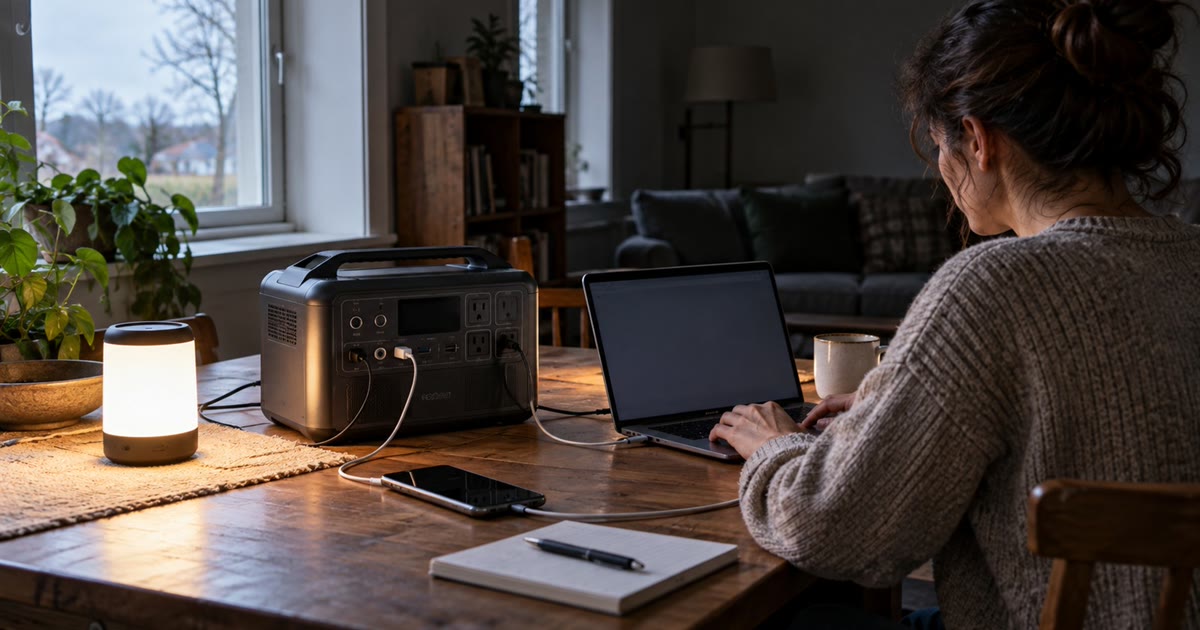
A portable power station is the easiest entry point into backup power — no installation, no fuel, just a battery that charges from the wall, your car, or solar panels. This guide covers best portable power stations: how to size one correctly, what specs actually matter, and the mistakes that lead to buying the wrong capacity.
Quick answer
Match capacity (watt-hours) to what you actually need to run, not the biggest number available. For phones, lights, and small electronics, 300–500Wh is enough. For a CPAP, a mini fridge, or charging multiple devices daily, look at 1,000–2,000Wh. Check the continuous and surge wattage rating separately from capacity — a device can fail to run even on a “big” power station if its startup draw exceeds the surge rating.
The two numbers that actually matter
- Capacity (Wh): total energy stored — how long it can run things before needing a recharge. A 1,000Wh unit can run a 100-watt device for about 10 hours (with some conversion loss).
- Output (W): how much power it can deliver at once. A unit can have huge capacity but a low output rating that can’t start a device with a high startup draw, like a refrigerator compressor or a power tool.
Both numbers matter independently — check your actual devices’ wattage (printed on the device or its power brick) against both the station’s continuous and surge/peak output rating.
Sizing by use case
- Phones, a lamp, a radio: 150–300Wh covers a day or two of light use.
- Add a laptop, router, and CPAP: 500–1,000Wh for a full day without recharging.
- Mini fridge, multiple devices, longer outages: 1,000–2,000Wh+, ideally paired with solar panels to recharge daily rather than running it down once.
- Power tools or anything with a motor: check the surge wattage specifically — motors draw 2–3x their running wattage on startup.
Battery chemistry: LiFePO4 vs. standard lithium-ion
- LiFePO4 (lithium iron phosphate): now standard in quality power stations — rated for roughly 2,000–3,500 charge cycles (meaning years of regular use before meaningful capacity loss), more heat-tolerant, and generally safer.
- Standard lithium-ion (NMC): lighter and sometimes cheaper, but typically rated for fewer cycles (500–1,000) before capacity degrades noticeably.
- For a unit you’ll use regularly or keep long-term, LiFePO4 is worth the premium.
Recharging options to check for
- Wall outlet (AC): standard, usually the fastest full recharge.
- Car charging (12V): useful for recharging on the move or from a vehicle during an outage.
- Solar input: check the maximum solar wattage the unit accepts and whether it’s sold with or compatible with panels — this is what makes a power station sustainable for a multi-day outage rather than a one-shot battery.
Other features worth checking
- Number and type of outlets — AC plugs, USB-A, USB-C (ideally with fast charging/PD support), and a 12V car-style port.
- Weight — larger capacity means more weight; if you need to carry it (not just keep it at home), this matters more than the spec sheet suggests.
- Pass-through charging — the ability to charge the station while simultaneously running devices from it.
- App/display monitoring — a clear readout of remaining capacity and current draw helps you ration power during a long outage.
A simple starter setup
For most households, a 1,000Wh-class power station paired with a 100W foldable solar panel covers phones, lights, a router, and a CPAP for a multi-day outage with daily solar recharging. See our full off-grid power basics guide for how to scale up from there, and our power station vs. generator comparison if you’re weighing both options.
Frequently asked questions
How do I know what size power station I need?
List the devices you want to run and their wattage, estimate hours of use per day, and multiply to get watt-hours needed. Add a buffer of 20 to 30 percent, and check that the station’s output rating (not just capacity) can handle your highest-draw device.
What’s the difference between capacity and output on a power station?
Capacity (watt-hours) is how much total energy it stores, determining runtime. Output (watts) is how much power it can deliver at once, determining what devices it can actually start and run, especially ones with high startup draw.
Is LiFePO4 battery chemistry worth paying more for?
Generally yes for regular or long-term use. LiFePO4 batteries last roughly 2,000 to 3,500 charge cycles compared to 500 to 1,000 for standard lithium-ion, meaning years more useful life before capacity degrades.
Can a portable power station run a refrigerator?
A small mini fridge, yes, if the station’s surge wattage rating exceeds the fridge’s compressor startup draw, which can be 2 to 3 times its running wattage. Check both numbers before assuming a station can handle it.
How long does it take to recharge a portable power station with solar?
It depends on the panel wattage, sunlight conditions, and the station’s maximum solar input rating, but a 100W panel in good sun might take most of a day to significantly recharge a 1,000Wh unit. Larger panels or multiple panels speed this up.
Do I need a power station if I already have a generator?
They serve different roles. A power station is silent, produces no exhaust, and can be used indoors, but has limited capacity. A generator provides more sustained power but needs fuel and must run outdoors. Many households use both.
Bottom line
Size a power station to your actual devices and their wattage, not the biggest number on the shelf, and check output rating alongside capacity. LiFePO4 chemistry and solar compatibility are worth prioritizing if you plan to rely on it for more than a one-time emergency.
Related guides
⚡ Off-Grid Power Basics
🔌 Portable Power Station vs. Generator
🔌 How to Prepare for a Long-Term Power Outage
This article is for general informational purposes only. Product availability, pricing, and specifications change; check current listings. Sources: manufacturer specifications (Jackery, EcoFlow, Goal Zero, Anker); U.S. Department of Energy battery storage guidance.