
This site stays free thanks to small commissions from links like the ones below — it never costs you anything extra, and it never changes what we recommend. As an Amazon Associate we earn from qualifying purchases. Learn more.
A serious storm, a job loss, a supply-chain snarl, or a two-week power outage all have the same fix: food in the house you don’t have to shop for. Building an emergency food supply sounds expensive and complicated, but a one-year pantry for one person can be assembled for a few hundred dollars if you buy the right staples in the right order. This guide covers how much to store, exactly what to buy, how to keep it for decades, how to rotate it so nothing is wasted, and a month-by-month plan you can start this week.
I ate a freeze-dried meal on day nine of a trip that was only supposed to last five, and it taught me two things: buy flavors you’ll actually want to eat, and always pack more than the trip requires. The same logic applies to a home pantry — the point isn’t the spreadsheet, it’s not running out.
Quick answer
Start with a two-week supply of food your family already eats, built from sales and a few extra items per shopping trip. Then extend to three months, then one year, prioritizing cheap calorie-dense staples: rice, beans, oats, pasta, flour, cooking oil, sugar, salt, and canned protein. Store them cool, dark, dry, and airtight, and rotate what you use. Add long-life freeze-dried buckets only after the basics are covered.
Build it in three stages
Stage 1: Two weeks (do this first)
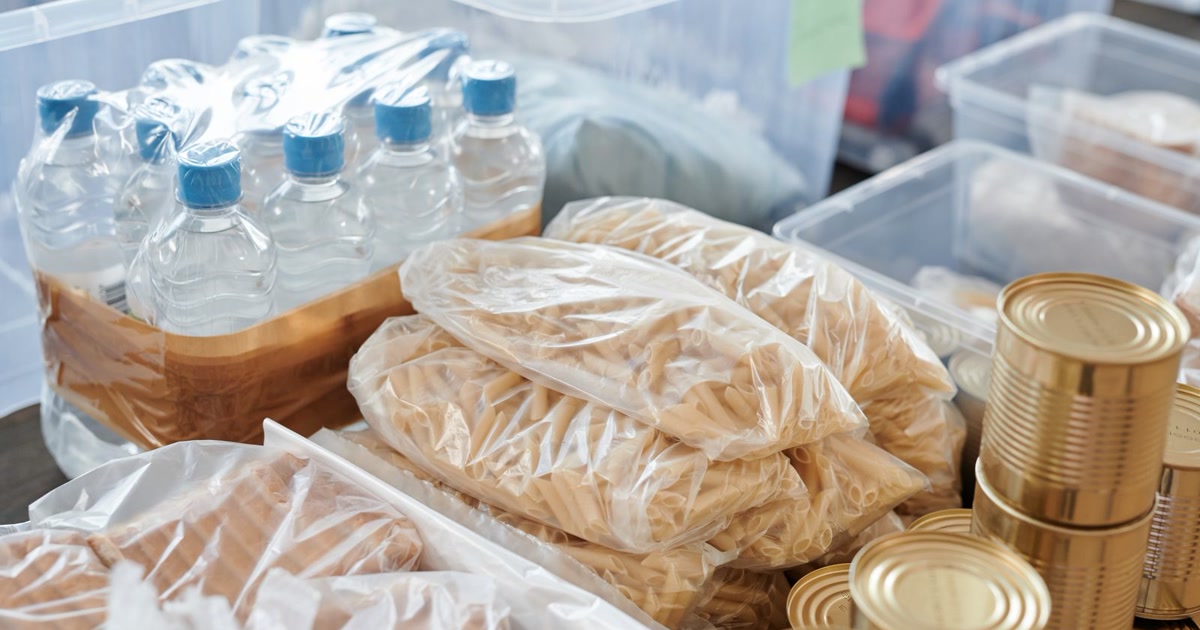
Buy two weeks of shelf-stable versions of meals you normally eat — canned chili, pasta and jarred sauce, peanut butter, crackers, canned fruit and vegetables, oatmeal, shelf-stable milk. Aim for about 2,000 calories per person per day. This alone covers the large majority of real-world emergencies. Cost: roughly $50–$80 per person.
Stage 2: Three months
Now add bulk staples and more canned protein, a little each shopping trip. Track what your household actually eats in a month and multiply by three. This is the sweet spot for job loss, extended illness, or a bad winter, and it’s where a small chest freezer and some bulk-bin shopping start to pay off.
Stage 3: One year
Extend the bulk staples to twelve months and fill gaps with long-term freeze-dried buckets for variety and grab-and-go convenience. A year of rice and beans is cheap insurance; the buckets make it bearable. Most people never go past three months, and that’s fine — a year is for those with the space, budget, and a real reason (rural location, large family, chronic supply issues).
How many calories do you actually need?
Serving counts on food-kit labels are marketing. Plan by calories instead. A sedentary adult needs roughly 1,600–2,000 calories a day to hold weight; during a real emergency, when you may be doing physical work, hauling water, or staying warm without heat, plan closer to 2,200–2,500. Children need less, teens and large or active adults need more.
Quick math for a family of four for one month: 4 people × 2,200 cal × 30 days = 264,000 calories. White rice delivers about 1,600 calories per dry pound, so rice alone would be 165 lb — obviously you want variety, but it shows how cheaply the calorie floor can be covered. Many budget “1-year” kits provide only 1,000–1,200 calories per day; read the label and do the division before you buy.
The cheapest calories to store
| Staple | Shelf life (stored well) | Approx. calories / lb | Why it earns its shelf space |
|---|---|---|---|
| White rice | 25+ years | ~1,600 | Cheap, filling, pairs with anything |
| Dried beans & lentils | 25+ years | ~1,500 | Protein + fiber; lentils cook fast, no soak |
| Rolled oats | 25+ years | ~1,700 | Breakfast, calories, fiber |
| Pasta | 8–10 years | ~1,600 | Familiar, fast to cook, kid-friendly |
| Hard wheat berries | 25+ years | ~1,500 | Grind for flour; far longer life than flour |
| Cooking oil | 1–2 years | ~4,000 | Most concentrated calories; rotate often |
| Sugar, honey | Indefinite | ~1,700–1,400 | Energy, preservation, morale |
| Salt | Indefinite | 0 | Preservation, electrolytes, flavor |
| Canned meat & fish | 2–5 years | ~500–900 | Ready-to-eat protein, no cooking |
| Powdered / shelf milk | 2–10 years | ~1,900 (dry) | Calcium, baking, coffee |
| Peanut butter | 1–2 years | ~2,600 | Calorie-dense, no prep, comfort food |
Also store a daily multivitamin — a staple-heavy diet is short on micronutrients — plus spices, bouillon, and drink mixes so meals don’t become punishment.
How to store it so it lasts
- Repackage dry staples (rice, beans, oats, wheat, pasta, flour) in Mylar bags with oxygen absorbers, sealed with a household iron or an impulse sealer, inside food-grade 5-gallon buckets with gamma lids. This is what turns a 1-year shelf life into a 25-year one. Use a 300–500 cc oxygen absorber per gallon of dry goods.
- Cool, dark, dry. Every 18°F (10°C) drop roughly doubles shelf life. A closet on an interior wall beats a hot garage or a damp basement floor. Aim for under 70°F.
- Off the floor on shelves or pallets, away from chemicals, solvents, and sunlight. Concrete wicks moisture — put a board or pallet under buckets.
- Freeze dry goods for 3–4 days before packing to kill any insect eggs (weevils), then let them return to room temperature before sealing so you don’t trap condensation.
- Label everything with contents and the pack date, and keep a simple inventory sheet on the door.
| Storage temperature | Effect on shelf life |
|---|---|
| 90°F+ (hot garage) | Cuts shelf life to a fraction; oils go rancid in months |
| 70°F (room) | Baseline — label estimates apply |
| 60°F (cool closet / basement) | Noticeably longer; ideal for most homes |
| 40–50°F (cellar) | Longest practical life for dry staples |
Rotate: first in, first out
Store what you eat, eat what you store. Shelve new purchases behind older ones, cook from the front, and replace as you go. A pantry you actually use never spoils and never surprises you with a decade-old bucket of something nobody will touch. Keep a printed inventory list with quantities and dates; update it when you add or use something. Check dates and the condition of cans (no bulging, rust, deep dents, or leaks) every few months. Short-life items — oil, nuts, whole-grain flour, crackers — go on a 6–12 month rotation; canned goods on 2–3 years; sealed Mylar staples you can leave for a decade.
A 12-week plan to reach three months
Add these on top of your normal groceries, adjusting quantities to household size. This spreads the cost over three months instead of one big hit.
- Weeks 1–2: 20 lb white rice, 10 lb dried beans, 6 lb rolled oats. Two cases of canned vegetables.
- Weeks 3–4: 10 lb pasta + 10 jars sauce. One case canned fruit. 2 lb peanut butter.
- Weeks 5–6: 20 cans of meat/fish (tuna, chicken, salmon, Spam). 1 gallon cooking oil. Salt, sugar.
- Weeks 7–8: Mylar bags, oxygen absorbers, and buckets. Repackage the rice, beans, and oats.
- Weeks 9–10: Powdered milk, coffee/tea, spices, bouillon, drink mixes. Comfort snacks.
- Weeks 11–12: A one-person 30-day freeze-dried bucket for variety, plus multivitamins and a manual can opener (buy two).
Water, cooking, and the extras
- Water: one gallon per person per day, two-week minimum, stored in food-grade containers away from light. See how to purify water for backup methods. Most stored staples need water to prepare — count that in.
- Off-grid cooking: a butane or propane stove with fuel, or a wood-burning rocket stove. Never run either indoors — carbon monoxide kills. Keep a stock of fuel canisters and a lighter.
- No-cook options: keep a few days of food that needs zero heat or water — canned goods, peanut butter, crackers, jerky, trail mix, granola bars — for the first hours of an emergency.
- Comfort: coffee, tea, hard candy, chocolate, spices, bouillon. Morale food matters more than people expect after a few grim days.
- Special needs: infant formula and baby food, pet food, and a two-week (ideally 30-day) supply of every prescription medication. Note allergies and diabetic needs in your plan.
Sample one-month supply for one adult
- 10 lb white rice, 8 lb dried beans/lentils, 7 lb rolled oats
- 6 lb pasta + 6 jars sauce
- 15 cans vegetables, 12 cans fruit, 20 cans meat/fish, 6 cans soup/chili
- 2 lb peanut butter, 1 lb powdered milk, 3 lb sugar, 1 lb salt, 1 L cooking oil
- Multivitamins, coffee/tea, spices, bouillon
That’s roughly 60,000–70,000 calories — about 2,000–2,300 per day for 30 days. Scale by household size and by how many meals you realistically cook at home.
Rough cost to get started
| Coverage | Approx. cost per person | Notes |
|---|---|---|
| 2 weeks | $50–$80 | Grocery-store food you already eat |
| 3 months | $200–$350 | Bulk staples + canned protein, spread over 12 weeks |
| 1 year (staples-heavy) | $500–$900 | Mostly rice/beans/oats/wheat in Mylar; buckets add cost fast |
Buy staples from warehouse clubs, restaurant-supply stores, ethnic grocers (best bean and rice prices), and case-lot sales. Bulk bins are cheapest per pound if your store has them.
Common mistakes
- Buying a year of freeze-dried before covering two weeks of normal food. Start cheap and familiar.
- Storing food you don’t eat. An emergency is the worst time to discover no one likes lentil loaf.
- Planning by “servings” instead of calories. Many kits hide a 1,200-calorie day behind a big serving count.
- No plan to cook it without power or gas, or no water to prepare it.
- Storing in a hot garage. Heat is the number-one killer of shelf life.
- Set-and-forget. Without rotation, oils go rancid and cans corrode.
Frequently asked questions
How much food should I store for emergencies?
Start with two weeks per person, then build to three months, then a year if you have space and budget. Two weeks handles most disasters; longer coverage protects against job loss, illness, and prolonged supply disruptions.
What is the cheapest emergency food to stockpile?
White rice, dried beans and lentils, rolled oats, pasta, and hard wheat berries — bought in bulk and repackaged for long-term storage. They deliver the most calories per dollar and last for decades when stored airtight and cool.
How do you store rice and beans for 25 years?
Seal them in food-grade Mylar bags with an oxygen absorber sized to the bag (300–500 cc per gallon), then place the bags in a lidded food-grade bucket, stored somewhere cool, dark, and dry. Oxygen, moisture, heat, and light are what shorten shelf life.
Are freeze-dried food buckets worth it?
They’re convenient, varied, and last 25–30 years, but cost several times more per calorie than bulk staples. Use them to add variety and quick meals once your cheap base layer is in place, not as your whole plan. Always check the calories-per-day on the label.
What foods last the longest without refrigeration?
Honey, salt, and sugar last essentially forever. White rice, dried beans, wheat berries, and rolled oats last 25+ years sealed. Canned goods run 2–5 years past their date if the can stays intact and cool.
How many calories per day should an emergency food supply provide?
Plan for about 2,000 calories per adult per day for normal conditions, and 2,200–2,500 if you’ll be doing physical work or keeping warm without heat. Children need less; active or larger adults need more. Divide a kit’s total calories by people and days before trusting its “X-day” claim.
How do I keep stored food from attracting pests?
Airtight containers — Mylar in buckets, or heavy sealed totes. Freeze dry goods for 3–4 days before packing to kill any insect eggs, keep the storage area clean and dry, and inspect every few months.
Where is the best place to store emergency food in a house?
An interior closet, an under-stairs space, a cool spare room, or a dry basement area — anywhere that stays under about 70°F, out of sunlight, and away from plumbing leaks. Avoid the garage and attic, which swing between extremes.
Can you eat canned food after the expiration date?
The date is a quality guideline, not a safety cutoff. An undamaged, properly stored can is generally safe well past it, though flavor and texture decline. Discard any can that is bulging, leaking, badly rusted, or spurts when opened.
Bottom line
Cover two weeks first with food you already eat, then grow it in stages. Lean on cheap staples for the bulk of your calories, store them airtight in a cool dark spot, rotate what you use, and don’t forget water and a way to cook. A year of food security costs less than most households’ monthly grocery bill spread over a year — and the two-week layer, which handles almost every real emergency, costs about the price of one big grocery run.
Related guides:
- How to Purify Water in the Wild
- How to Build the Perfect 72-Hour Survival Kit
- How to Build a Survival First Aid Kit
- Best Survival Water Filters, Ranked
This article is for general informational purposes only. Sources: Ready.gov “Food” and “Build a Kit”; USDA FoodKeeper; Utah State University Extension food storage guidance; American Red Cross; U.S. FDA on canned food safety.