
This site stays free thanks to small commissions from links like the ones below — it never costs you anything extra, and it never changes what we recommend. As an Amazon Associate we earn from qualifying purchases. Learn more.
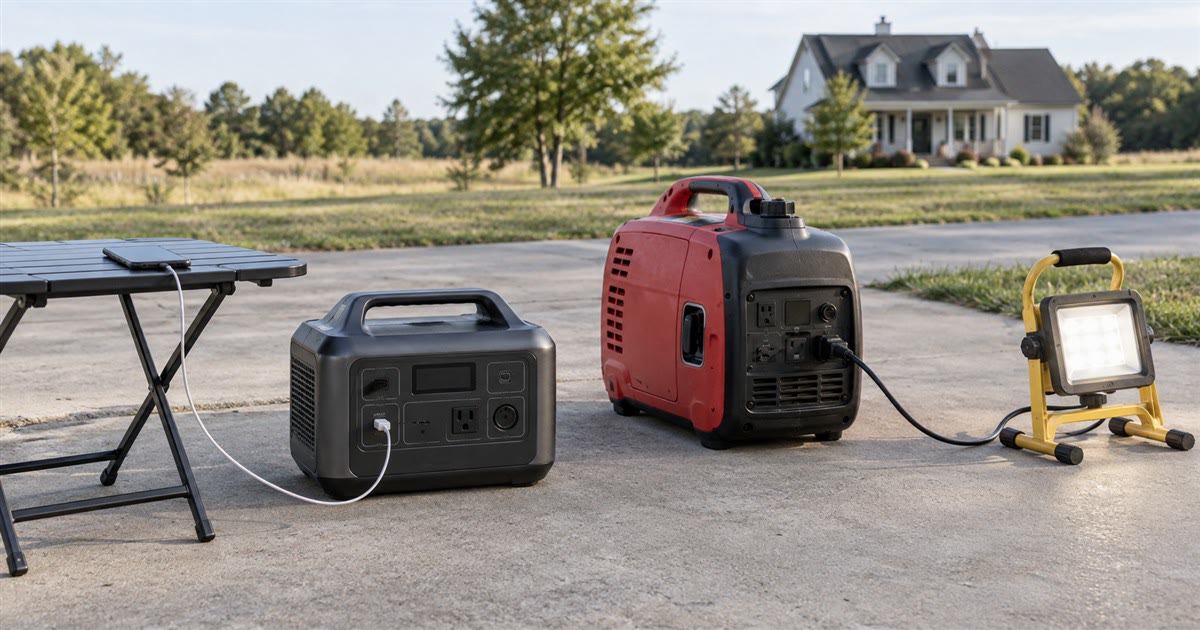
Quick answer: Choose a portable power station (battery-based) for quiet, indoor-safe backup of essentials like phones, medical devices, and a fridge for a day — choose a fuel generator if you need to run a whole home, well pump, or high-wattage appliances for multiple days.
Side-by-Side Comparison
| Portable Power Station | Fuel Generator | |
|---|---|---|
| Runs indoors safely? | Yes — zero emissions | No — CO risk, outdoor only |
| Noise | Silent | Loud (60-75 dB typical) |
| Runtime | Hours (until battery depletes) | As long as fuel supply lasts |
| Total power output | Lower (typically 300W-3000W) | Higher (2000W-10,000W+) |
| Refueling | Recharge via wall, solar, or car | Requires stored gasoline/propane |
| Maintenance | Minimal | Oil changes, fuel stabilizer, engine upkeep |
| Upfront cost (comparable capacity) | Higher per watt | Lower per watt |
Who Should Get a Power Station
- Apartment/condo dwellers with no safe outdoor space to run a generator
- Anyone needing to power medical equipment (CPAP, oxygen concentrator) quietly and safely indoors
- Short outages (a few hours to a day) where whole-home power isn’t the goal
- Pairing with solar panels for renewable recharging off-grid
Who Should Get a Generator
- Homes with a well pump, sump pump, or furnace that needs real wattage to run
- Outages lasting multiple days where recharging a battery isn’t practical
- Rural properties with space to run a generator safely away from the house
- Portable power station (1000Wh+ class) — Check Price on Amazon
- Dual-fuel portable generator — Check Price on Amazon
- Foldable solar panel for power station recharging — Check Price on Amazon
Common Mistakes
Frequently Asked Questions
Can a power station run a refrigerator?
Yes, for a limited time — a 1000-2000Wh power station can typically run a standard fridge for roughly 8-20 hours depending on the model, useful for a short outage but not a multi-day one without solar recharging.
Is it worth owning both a generator and a power station?
For many households, yes — a power station covers short/quiet/indoor needs, while a generator handles extended outages or high-wattage equipment, and they don’t compete for the same use case.
How do I calculate what size power station or generator I need?
Add up the running wattage of the devices you want to power simultaneously (check appliance labels), then add a safety margin of about 20% — most manufacturers publish sizing calculators for this too.
Can I recharge a power station with solar panels during an outage?
Yes, if it has solar input (most portable power stations do) — this is one of its biggest advantages over a generator during an extended outage without fuel resupply.