
This site stays free thanks to small commissions from links like the ones below — it never costs you anything extra, and it never changes what we recommend. As an Amazon Associate we earn from qualifying purchases. Learn more.
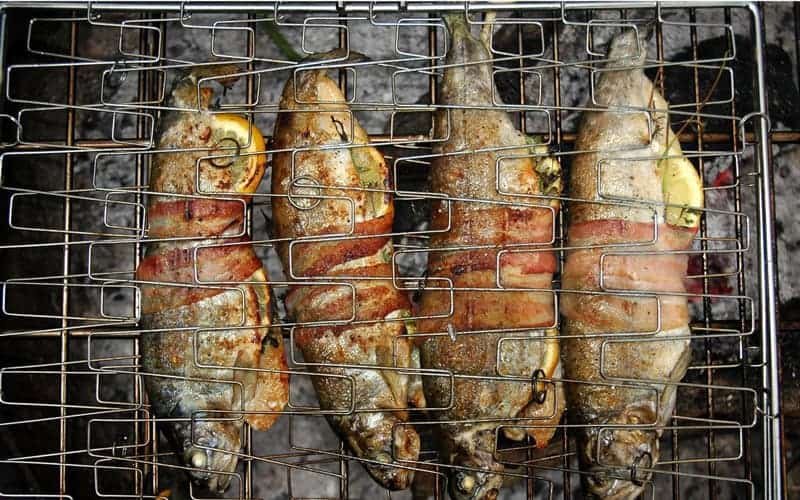
A fresh-caught fish and a campfire is one of the oldest meals there is — and one of the easiest to get wrong, ending with charred skin and raw middle. This guide covers how to cook fish over a campfire: cleaning it, four reliable methods, how to know it’s done, and how to do it with almost no gear.
Quick answer
Clean and gut the fish, cook it over coals, not flames, and use skin or foil to keep it from sticking and falling apart. The simplest reliable method is to wrap a whole cleaned fish in foil with a little oil, salt, and lemon and set it in the coals for 10–15 minutes. Fish is done when the flesh turns opaque and flakes easily and reaches 145°F internally.
Clean the fish first
- Scale it (if you’re keeping the skin) by scraping tail-to-head with a knife back or spoon.
- Gut it: slit the belly from vent to gills, pull out the innards, and scrape the dark bloodline along the spine.
- Gills out — they spoil fast and taste bitter.
- Rinse in clean water, pat dry. Leave small fish (under ~10 in) whole; fillet or steak larger ones.
- Do this away from camp and downstream, and pack out or bury the guts well away from your site so you don’t attract animals.
Build the right fire
Let the fire burn down to a bed of glowing coals with low flames. Direct flame scorches the outside before the inside cooks and coats the fish in soot. A steady coal bed gives even, controllable heat. Have a spot at the edge of the fire that’s a little cooler so you can move food off the hottest coals.
Four ways to cook it
1. Foil packet (easiest, most forgiving)
Lay the cleaned fish on a double layer of heavy-duty foil. Add a spoon of oil or butter, salt, pepper, and slices of lemon or wild onion inside the cavity. Fold into a sealed packet, set on the coals, and cook 10–15 minutes for a 1-lb fish, turning once. Open carefully — steam. Fillets take 6–10 minutes.
2. On a stick / plank
Skewer a small whole fish or a fillet lengthwise on a green (living) hardwood stick and prop it beside the coals like a marshmallow, skin toward the heat, turning every few minutes. For fillets, lash them skin-side-down to a split green plank and lean it toward the fire. Slower, but no foil needed.
3. In a pan or on a rock
A cast-iron or steel skillet on a grate or three flat stones over the coals: a little oil, skin-side down first, 3–5 minutes a side for a fillet. A large, clean, dry flat rock heated at the fire’s edge works as a griddle in a pinch (never use wet or river rocks near a fire — trapped moisture can make them crack or burst).
4. Wrapped in leaves
Big non-toxic leaves — grape, sycamore, burdock, or corn husks — wrapped around a seasoned fish and tied with a fiber, then set on the coals for 10–15 minutes. The leaves char and steam the fish inside. Peel them away to serve.
How to tell it’s done
- The flesh turns from translucent to opaque and flakes when you twist a fork in the thickest part.
- A skewer or knife tip slides in with no resistance.
- On a whole fish, the dorsal fin pulls out cleanly.
- If you have one, an internal temperature of 145°F is the food-safety target.
- Undercooked fish looks glassy and mushy in the center. Put it back on for a few minutes.
No-gear version
Cleaned fish + a green stick + a coal bed = dinner. Or bury a leaf-wrapped, mud-packed fish directly in the coals (the classic “mud fish”) for 15–20 minutes; crack off the hardened clay and the skin and scales come with it. Season with nothing but salt if that’s all you have.
Common mistakes
- Cooking over flames instead of coals — burnt outside, raw inside, sooty taste.
- Skinless fillet straight on a grate — it sticks and shreds. Keep skin on or use foil.
- Not drying the fish — wet skin steams and sticks instead of crisping.
- Overcooking — fish goes from perfect to dry in a minute or two. Pull it as soon as it flakes.
- Wet river rocks near the fire — they can crack sharply.
Frequently asked questions
How long does it take to cook fish over a campfire?
A whole 1-pound fish in a foil packet on hot coals takes about 10 to 15 minutes, turning once. Fillets take 6 to 10 minutes. It is done when the flesh is opaque and flakes easily, or reaches 145°F inside.
Should you cook fish over flames or coals?
Coals. A bed of glowing coals gives steady, even heat that cooks the fish through without scorching the outside or coating it in soot. Direct flame burns the surface before the center is done.
Do you need to gut a fish before cooking it on a fire?
Yes. Remove the guts and gills and rinse the cavity. Left in, they spoil quickly, taste bitter, and can make the fish unsafe. Small fish can be cooked whole once cleaned; larger fish are easier as fillets or steaks.
How do you cook fish over a fire without foil or a pan?
Skewer a small cleaned fish on a green hardwood stick and prop it beside the coals, turning often; lash a fillet skin-side-down to a split green plank leaned toward the fire; or wrap the fish in large non-toxic leaves and set it on the coals.
What temperature should cooked fish reach?
145°F internal temperature is the food-safety target. Without a thermometer, look for flesh that has turned fully opaque and flakes cleanly when twisted with a fork, with no glassy or mushy center.
Can you cook fish directly on hot coals?
Yes — a whole cleaned fish wrapped in wet leaves and a coating of clay or mud can be buried in the coals for 15 to 20 minutes. Crack off the hardened shell and the scales and skin lift away with it.
Bottom line
Clean the fish well, wait for coals instead of flames, keep the skin on or use foil so it doesn’t stick, and pull it the moment it flakes. A stick and a coal bed are all you actually need.
Related guides
🔥 How to Start a Fire Without Matches
🍞 How to Preserve Meat Without Refrigeration
🥩 15 Wilderness Survival Skills
This article is for general informational purposes only. Follow local fishing regulations and fire rules. Sources: USDA FSIS safe cooking temperatures; U.S. Forest Service campfire guidance; NOAA Fisheries.