
The Survival Life is reader-supported. When you buy through links on our site, we may earn an affiliate commission at no extra cost to you. As an Amazon Associate we earn from qualifying purchases. Learn more.
Hurricanes are one of the few major disasters you get days of warning for — and that lead time is exactly what most people waste. This is a practical hurricane preparedness checklist for your home: what to do at the start of the season, what to do when a storm is named and headed your way, what to do in the last 24 hours, and what to do after it passes.
Quick answer
Before hurricane season: build a two-week supply of water and food, assemble a go-bag per person, protect your documents, and know your evacuation zone and route. When a storm is forecast: fuel up, fill water, charge everything, secure or bring in outdoor items, and decide early whether you’re staying or leaving. If officials say evacuate, evacuate — storm surge is the deadliest part of a hurricane.
Start-of-season checklist (do once, in advance)
- Water: one gallon per person per day, two-week supply. Add a few large containers you can fill fast.
- Food: two weeks of no-cook, shelf-stable food. See how to build an emergency food supply.
- Power & light: headlamps, lanterns, spare batteries, power banks, and a NOAA weather radio. If you own a generator, service it and stock fuel and a stabilizer now — not the day before.
- First aid: a stocked kit plus a two-week supply of every prescription. See how to build a first aid kit.
- Documents: ID, insurance policies, deeds, medical info, and photos of your home’s condition in a waterproof document bag, plus digital copies in the cloud.
- Home: know where your water, gas, and electrical shutoffs are and keep the right shutoff wrench nearby. Trim dead branches. Check that shutters or plywood panels fit and the hardware is on hand.
- Plan: look up your official evacuation zone, pick two routes inland, agree on an out-of-area contact everyone calls, and identify a pet-friendly destination.
When a storm is named and forecast to hit (2–3 days out)
- Fill vehicle fuel tanks and get cash.
- Fill water containers, pots, and clean bottles; sanitize and fill the bathtub as flush/wash water.
- Refill prescriptions; restock any thin spots in food and batteries.
- Charge every phone, laptop, power bank, and power station.
- Bring in or tie down anything that can become a projectile: patio furniture, grills, planters, trash cans, kids’ toys, decor.
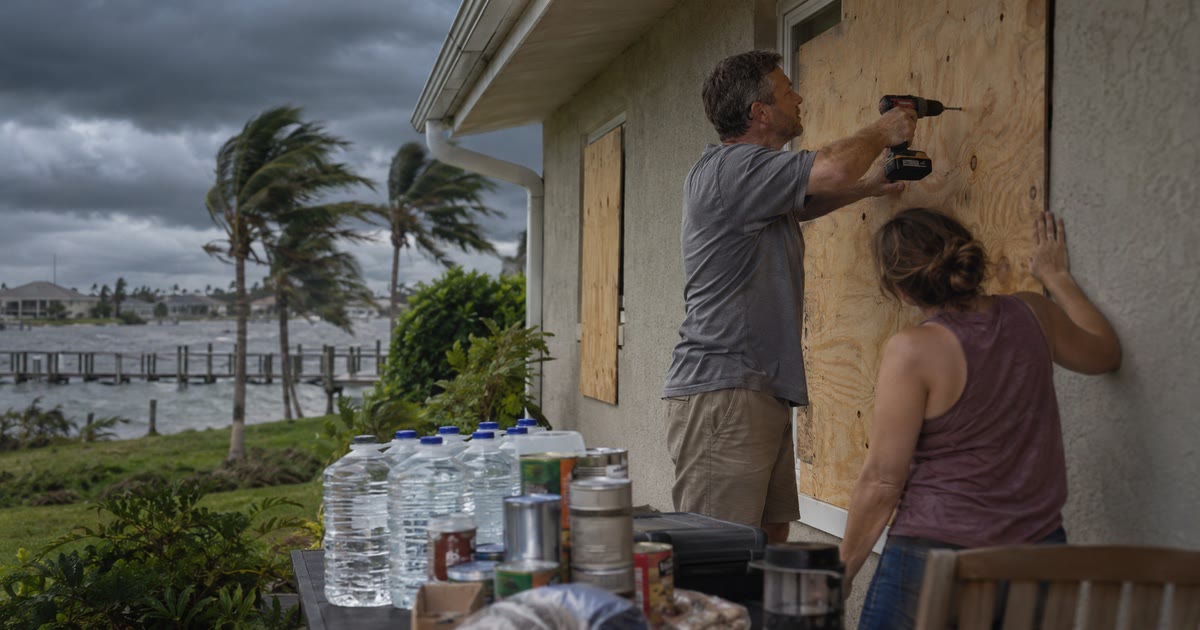
- Put up shutters or plywood. Do not tape windows — it does nothing and creates larger glass shards.
- Decide now: staying or evacuating. If you’re in a surge zone, a mobile home, or a flood-prone area, leave. Leaving early beats sitting in gridlock.
- Photograph or video every room and your home’s exterior for insurance.
Last 24 hours
- Turn the fridge and freezer to their coldest setting; freeze water bottles to help hold temperature and provide drinking water later.
- Clear gutters and storm drains near your property if it’s safe.
- Move valuables and electronics upstairs or off the floor.
- Park vehicles in the garage or on high ground, away from trees.
- Fill the go-bags, load the car if evacuating, and keep shoes and a flashlight by the bed.
- Unplug electronics. If flooding is possible and you can do it safely, shut off electricity at the breaker.
During the storm
- Stay inside, away from windows — a small interior room or hallway on the lowest floor that won’t flood.
- If the eye passes over, the calm is temporary. Winds return from the opposite direction, often just as strong. Stay put.
- Do not run a generator indoors or in the garage. Ever.
- Listen to the weather radio for instructions and don’t rely on cell service.
- If water rises inside, move up — but never into a closed attic you can’t get out of. Take an axe or tools if you go up.
After it passes
- Assume every downed line is live. Stay away from standing water near power lines.
- Don’t drive through flooded roads — a foot of moving water floats most cars, and you can’t see washouts.
- Check for gas leaks (smell, hissing). If you suspect one, leave and call from outside.
- Photograph all damage before you clean up or make temporary repairs; keep receipts.
- Use bottled or boiled water until officials say tap water is safe.
- Watch for heat, exhaustion, and injuries during cleanup. Wear gloves and sturdy boots; be careful with chainsaws and ladders.
Common mistakes
- Waiting for the “cone” to point at you. Prep when a storm is named; forecasts shift.
- Ignoring an evacuation order because past storms “weren’t that bad.” Surge and inland flooding are the killers.
- Taping windows. Useless, and it makes bigger shards.
- Running a generator in the garage. Carbon monoxide kills families every hurricane season.
- No cash and an empty gas tank when the power and pumps go down for a week.
Frequently asked questions
How far in advance should I prepare for a hurricane?
Do the big, slow tasks — water and food supply, go-bags, documents, knowing your evacuation zone — before hurricane season starts. Do the fast tasks — fuel, water, batteries, securing the yard, boarding windows — as soon as a storm is named and forecast to approach, usually 2 to 3 days out.
Should I evacuate or shelter in place during a hurricane?
Follow official orders. If you live in a storm-surge zone, a mobile or manufactured home, a high-rise, or a flood-prone area, evacuate. Leaving early, before roads clog, is far safer than leaving late or staying in an unsafe structure.
Does taping windows help during a hurricane?
No. Tape does not strengthen glass and can cause it to break into larger, more dangerous pieces. Use storm shutters or properly cut and fastened plywood instead.
How much water should I store for a hurricane?
One gallon per person per day for at least two weeks, since utilities and stores can be down for a week or more after a major storm. Fill extra containers and the bathtub when a storm is forecast.
Is it safe to be outside during the eye of a hurricane?
No. The eye is a brief lull. Damaging winds return suddenly from the opposite direction, often at full strength. Stay sheltered until officials confirm the storm has fully passed.
What should I do with important documents before a hurricane?
Put originals of ID, insurance, property, and medical records in a waterproof, fireproof bag, keep digital copies in cloud storage, and photograph or video every room of your home for insurance claims.
Bottom line
The households that come through a hurricane well are the ones that did the slow prep before the season and acted on the first forecast, not the last. Know your zone, keep two weeks of water and food, protect your documents, and if they tell you to go — go early.
Related guides:
- How to Prepare for a Long-Term Power Outage
- Emergency Food Supply on a Budget
- Get-Home Bag Checklist
- How to Purify Water in the Wild
This article is for general informational purposes only. Follow the instructions of your local emergency management officials. Sources: Ready.gov “Hurricanes”; National Hurricane Center / NOAA; FEMA; American Red Cross.