
This site stays free thanks to small commissions from links like the ones below — it never costs you anything extra, and it never changes what we recommend. As an Amazon Associate we earn from qualifying purchases. Learn more.
Quick answer: Store white rice and dried beans in food-grade Mylar bags with oxygen absorbers, sealed inside food-grade 5-gallon buckets, kept cool and dry. Done right, this combination can last 20-30 years for rice and 8-10+ years for beans — far longer than the original packaging suggests.
Why Rice and Beans Are the Backbone of Long-Term Food Storage
Together, rice and beans form a complete protein and are cheap, calorie-dense, and shelf-stable when stored correctly. A 25-lb bag of rice provides roughly 41,000 calories — enough to matter in a real emergency — for a fraction of the cost of freeze-dried meals.
What You Need
| Item | Purpose |
|---|---|
| Food-grade 5-gallon bucket | Rigid outer barrier against rodents and crushing |
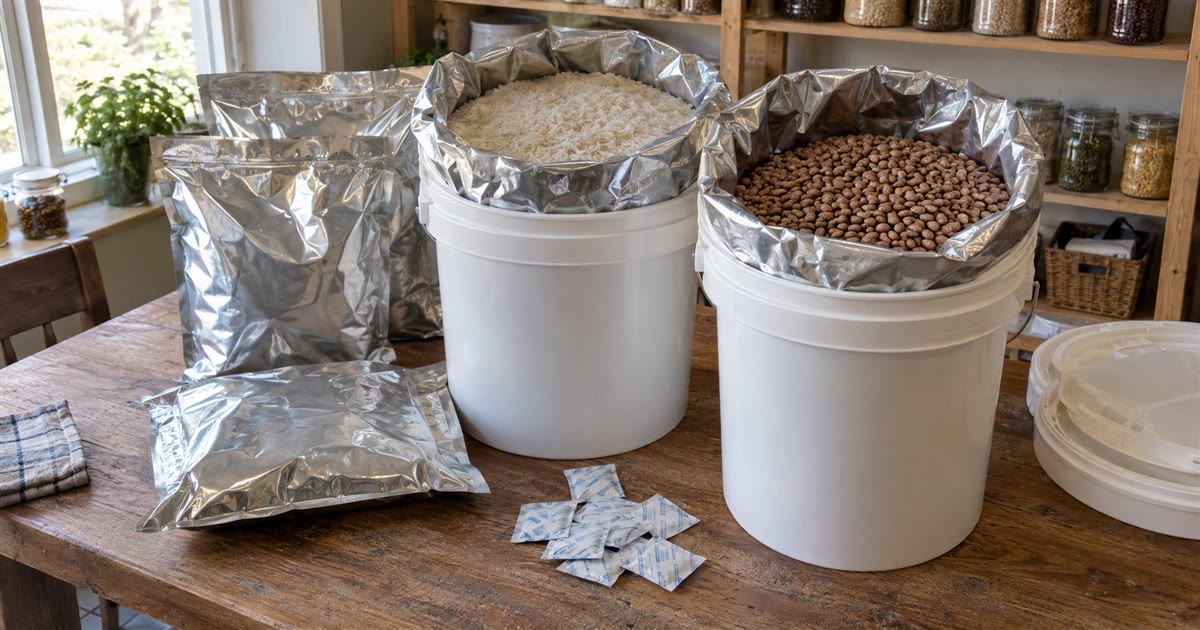
| Mylar bag (5-6 mil, sized for a 5-gal bucket) | Blocks light, moisture, and oxygen — the real preservation layer |
| Oxygen absorbers (300-2000cc depending on bucket size) | Removes residual oxygen so insect eggs can’t survive and fats don’t go rancid |
| Iron or hair straightener / heat sealer | Seals the top of the Mylar bag |
- Food-grade 5-gallon buckets with gasket lids — Check Price on Amazon
- Mylar bags for 5-gallon buckets — Check Price on Amazon
- 2000cc oxygen absorbers — Check Price on Amazon
- Bucket opener/wrench — Check Price on Amazon
Step-by-Step Packing Process
- Line the bucket with a Mylar bag, folding the excess over the rim.
- Fill with rice or beans, leaving a few inches of headspace.
- Drop in the correct-size oxygen absorber right before sealing (they start working the moment they’re exposed to air, so keep unused absorbers in their own sealed jar between uses).
- Press out excess air, then seal the top of the Mylar bag flat with a hot iron or hair straightener along a straight edge — you want a solid, wrinkle-free seal.
- Snap the bucket lid on firmly, using a rubber mallet to seat the gasket evenly.
- Label with contents and pack date on the outside.
How Long It Actually Lasts
- White rice: 20-30 years when sealed properly — the low fat content is why it stores so well.
- Dried beans: 8-10+ years sealed, though very old beans (“hard-to-cook” beans) take longer to soften when cooked — still safe, just tougher.
- Brown rice: Only 6-12 months even sealed, because the bran layer contains oils that go rancid — stick to white rice for true long-term storage.
Common Mistakes
Frequently Asked Questions
Do I need to add oxygen absorbers if I’m just using a bucket without Mylar?
You should still use both together — plastic buckets alone aren’t a complete oxygen or moisture barrier on their own; the Mylar bag is what does the real preservation work.
Can I store rice and beans together in the same bucket?
It’s better to keep them separate (different bags within the same bucket, or separate buckets) since they have different long-term storage windows and you may want to use one before the other.
How do I know if an oxygen absorber worked?
The Mylar bag should pull in tight and feel vacuum-sealed within a day or two after sealing — if it stays loose/puffy, the seal likely failed or the absorber was already spent.
Is it safe to eat rice or beans stored for 20+ years?
Yes, if properly sealed and stored cool/dry — the main risk with age is texture and cook time, not safety, as long as no moisture or pests got in.