
This site stays free thanks to small commissions from links like the ones below — it never costs you anything extra, and it never changes what we recommend. As an Amazon Associate we earn from qualifying purchases. Learn more.
Quick answer: Use the universal signal of three (three whistle blasts, three fires, three flashes) since “three of anything” is internationally recognized as a distress signal. Combine sound (whistle), light (mirror, flashlight, fire), and visual ground signals (large contrasting shapes) to maximize your chances across day and night.
Signal by Sound: Whistle
A whistle carries much farther than your voice and doesn’t tire out your throat. Three sharp blasts, pause, repeat — this pattern is recognized worldwide as a distress call.
Signal by Light: Mirror and Fire
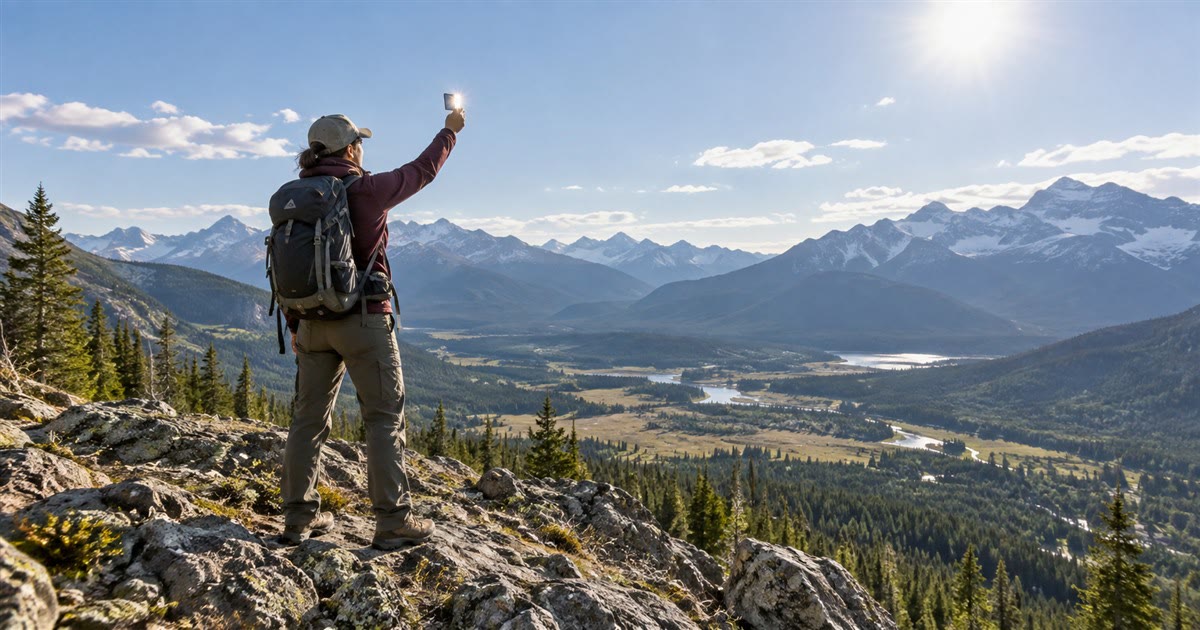
- Signal mirror: On a sunny day, a mirror flash can be seen for miles by aircraft or search parties — aim by holding out your other hand, forming a V with your fingers around the target, and flashing through the gap.
- Fire at night: Three fires in a triangle or a line is a recognized distress pattern, far more visible than a single fire from the air.
- Flashlight/headlamp: Three flashes, repeated, works the same way as the whistle pattern.
- Signal mirror (glass, with aiming hole) — Check Price on Amazon
- Loud emergency whistle — Check Price on Amazon
- Personal locator beacon (PLB) — Check Price on Amazon
- High-visibility emergency panel/tarp — Check Price on Amazon
Ground-to-Air Signals
If you expect aerial search, build large, high-contrast shapes on open ground — an X (need medical help) or a V (need assistance) made from logs, rocks, or bright clothing, sized at least 10 feet across so it’s visible from altitude.
The Best Signal: A Personal Locator Beacon
For serious backcountry travel, a PLB or satellite messenger transmits your exact GPS location to search and rescue via satellite — no cell signal needed. This is the single most reliable way to get located quickly and is worth the investment for remote trips.
Common Mistakes
Frequently Asked Questions
What’s the universal distress signal?
Three of anything — three whistle blasts, three fires, three flashes of light — is internationally recognized as a call for help, versus one or two which could be mistaken for normal activity.
Do signal mirrors really work without sunlight?
No, they rely on reflecting direct sunlight, so they’re a daytime-only tool — at night, fire or flashlight signals take over that role.
Is a personal locator beacon worth the cost for occasional hikers?
If you frequently go into areas without cell coverage, yes — it’s one of the highest-value safety purchases for the actual worst-case scenario, even if it’s rarely used.
How far can a signal mirror flash be seen?
Under good conditions, a mirror flash can be spotted by aircraft from several miles away, making it one of the most effective low-tech signaling tools available.