
This site stays free thanks to small commissions from links like the ones below — it never costs you anything extra, and it never changes what we recommend. As an Amazon Associate we earn from qualifying purchases. Learn more.
Quick answer: Never run a generator inside a house, garage, basement, or any enclosed/partially enclosed space — even with doors open. Place it at least 20 feet from windows, doors, and vents, pointed away from the home, and install battery-powered CO detectors inside regardless.
The 20-Foot Rule
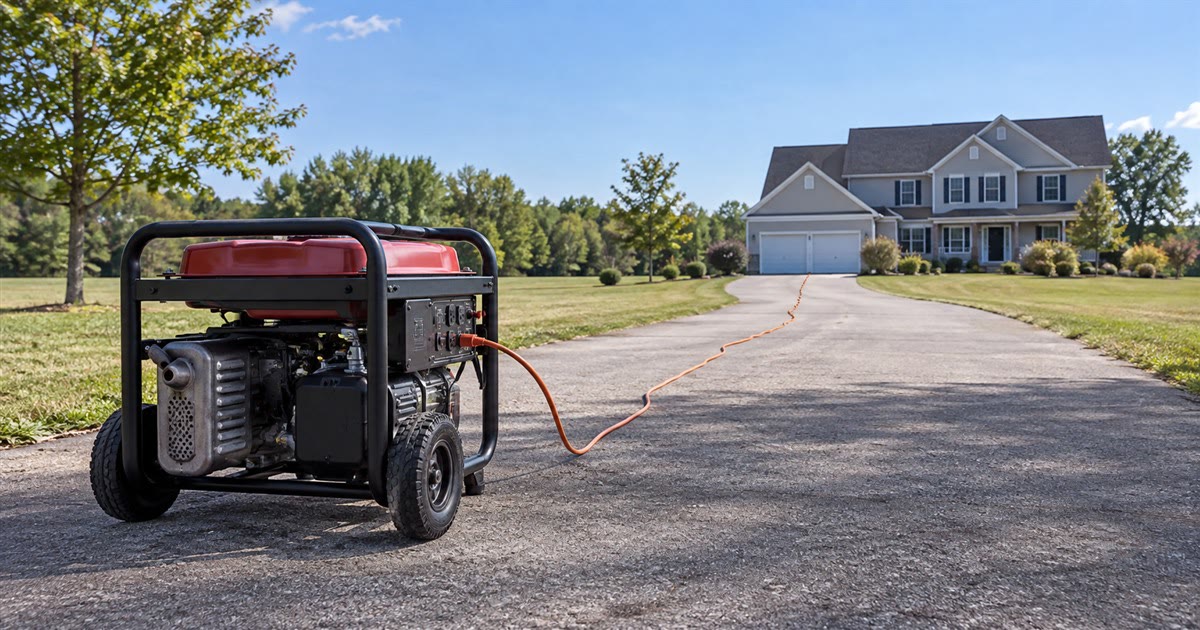
Generators must run outdoors, at least 20 feet from any window, door, or vent, with the exhaust pointed away from the house. A garage with the door open is not safe — CO still accumulates and drifts indoors.
- Battery-powered CO detector (no electricity needed) — Check Price on Amazon
- Generator extension cord (heavy-duty, outdoor-rated) — Check Price on Amazon
- Portable generator with CO shutoff sensor — Check Price on Amazon
Signs of Carbon Monoxide Poisoning
- Headache, dizziness, weakness
- Nausea, vomiting, confusion
- Chest pain, shortness of breath
- Loss of consciousness (in severe cases)
If anyone shows these symptoms while a generator is running nearby, get them to fresh air immediately and call 911 — don’t wait to see if symptoms pass.
Other Generator Safety Basics
- Let the generator cool before refueling — hot engine + spilled gasoline is a fire risk.
- Never connect a generator directly to household wiring without a properly installed transfer switch — this can backfeed the grid and electrocute utility workers.
- Keep it dry — operate under an open canopy, never in rain, to avoid electrocution risk.
Common Mistakes
Frequently Asked Questions
Can carbon monoxide from a generator outside still get into my house?
Yes — CO can seep in through windows, doors, vents, and even small gaps if the generator is too close to the structure, which is why the 20-foot minimum distance matters.
Do CO detectors need electricity to work?
Battery-powered CO detectors are specifically recommended for outage situations, since plug-in-only detectors are useless exactly when you need them most — during a power outage.
How much CO does it take to be dangerous?
Even moderate concentrations become dangerous with prolonged exposure; CO poisoning can occur within minutes at high concentrations, which is why enclosed-space generator use is never acceptable, even briefly.
Is a dual-fuel or solar generator safer regarding CO?
Battery/solar power stations produce zero CO and can run indoors safely, making them the safer choice for indoor backup power for smaller loads, though they carry less total wattage than a fuel generator for whole-home needs.