This site stays free thanks to small commissions from links like the ones below — it never costs you anything extra, and it never changes what we recommend. As an Amazon Associate we earn from qualifying purchases. Learn more.
Wild mushroom foraging kills and hospitalizes people every single year in the U.S. — not because the information is unavailable, but because mushroom identification is genuinely harder than most guides admit, and the deadliest species mimic safe-looking ones closely enough to fool experienced foragers. This guide covers wild mushroom foraging safety: the real rules, the myths that get people hurt, and why no blog post (including this one) can substitute for in-person expert verification.
Quick answer
There is no universal visual rule, folk test, or single feature that reliably separates edible mushrooms from deadly ones — safe foraging requires positive identification of the exact species, confirmed through multiple reliable sources (field guides, spore prints, and ideally an experienced local expert), every single time, with zero exceptions for “probably fine.”
Why this is genuinely more dangerous than most foraging advice
Several of the most toxic mushrooms in North America — most notoriously species in the Amanita genus, including death caps and destroying angels — closely resemble common edible species at certain growth stages, to the point that experienced mycologists have been fatally poisoned by misidentification. The toxins in these species cause severe liver and kidney damage, often with a dangerous delay of 6-24 hours before symptoms appear, by which point significant internal damage has already occurred. This isn’t a food safety issue like undercooked chicken — it’s closer to handling an unlabeled chemical.
Myths that get people hurt
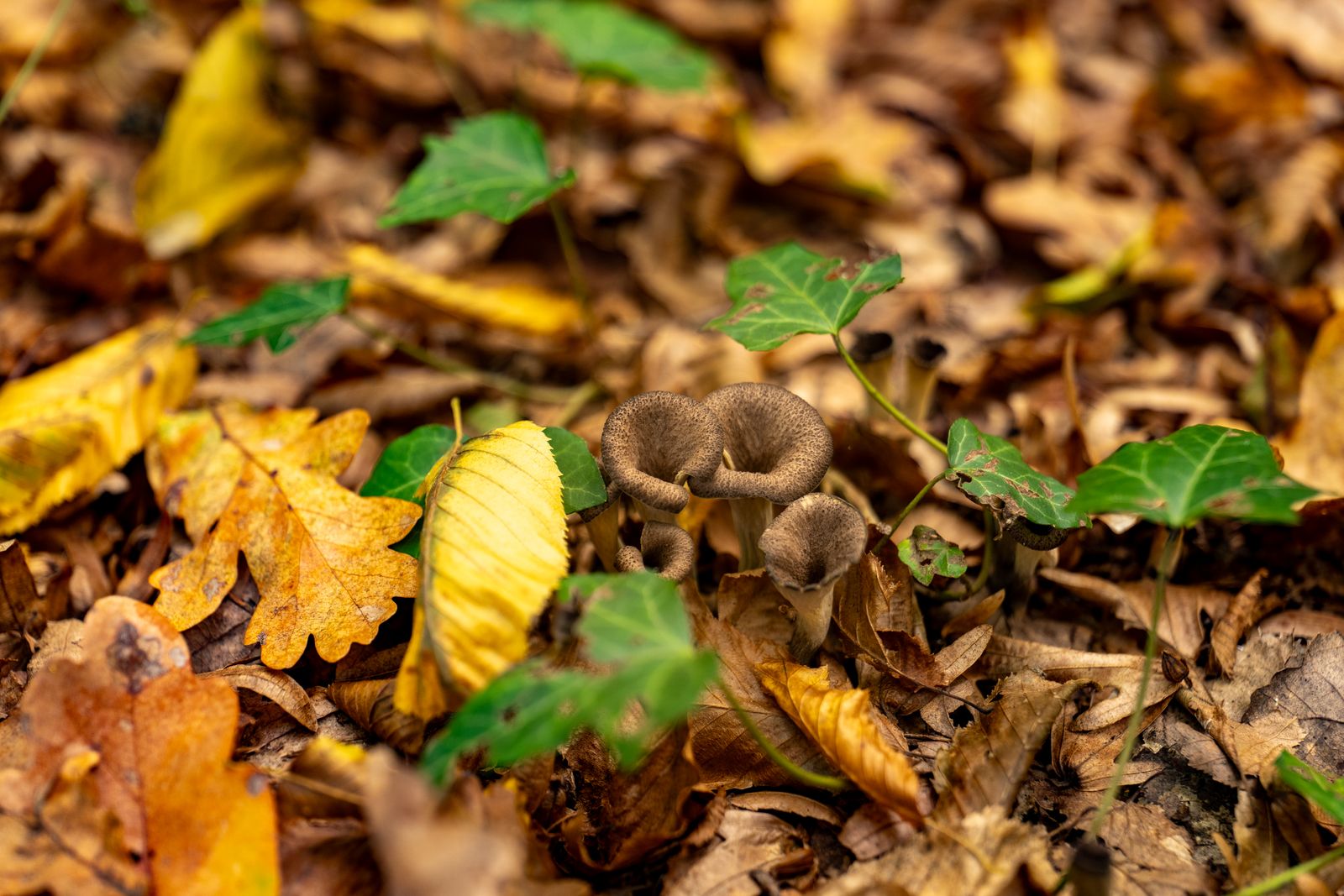
Wild mushrooms in forest leaf litter — for illustration only; never identify species or edibility from a photo.
- “If animals eat it, it’s safe for humans” — false. Many animals can safely eat mushrooms that are lethal to humans due to different digestive systems and toxin sensitivity.
- “Poisonous mushrooms taste bad” — false and dangerous. Some of the deadliest species, including death caps, are reported to taste mild or even pleasant; taste is not a safety indicator and should never be used to test a mushroom.
- “A silver spoon will tarnish near poisonous mushrooms” — false, a folk test with no scientific basis whatsoever.
- “Insects or slugs eating it means it’s safe” — false, for the same reason as the animal-eating myth; insect tolerance doesn’t indicate human safety.
- “Peeling the cap removes the toxin” — false for most seriously toxic species; the toxins are typically distributed throughout the mushroom, not concentrated in the skin.
- “Cooking neutralizes the poison” — false for the most dangerous toxins (including amatoxins in death caps), which survive cooking, drying, and freezing completely intact.
Every one of these “tests” has been responsible for real poisonings when foragers trusted them instead of actual identification.
What real identification actually requires
Positive identification of a wild mushroom species typically requires examining multiple physical features together: cap shape and color, gill attachment and color, stem features (including the presence or absence of a ring and a volva/cup at the base — critical for ruling out Amanita species), spore print color (obtained by placing the cap gill-down on paper overnight), habitat and substrate, and season. Missing even one of these features, especially the volva at the base of the stem, has led to fatal misidentification of Amanita species as safe lookalikes.
The role of expert verification
Local mycological societies exist specifically because reliable mushroom identification benefits enormously from in-person, hands-on expertise that no photo, app, or written guide fully replaces — many societies offer identification walks, meetings, or will review a specimen in person before you’d consider eating it. Mushroom identification apps using photo recognition have documented failure rates serious enough that mycological organizations specifically warn against relying on them alone for edibility decisions.
Safe foraging practices
- Never eat anything based on a single feature, a photo match, or an app identification alone.
- Take a spore print and examine the full specimen, including digging up (not cutting) the base to check for a volva.
- Cross-reference with at least two independent, reputable field guides specific to your region, since species and look-alikes vary significantly by location.
- When genuinely uncertain, don’t eat it — there is no “probably fine” in mushroom foraging.
- Keep a specimen of anything you do eat until you’re certain no reaction occurs, in case medical identification is needed later.
If someone may have eaten a toxic mushroom
Treat any suspected wild mushroom poisoning as a medical emergency, even if the person feels fine initially — the most dangerous toxins specifically cause a delayed onset of symptoms, which can create false reassurance before serious organ damage is already underway. Contact Poison Control (in the U.S., 1-800-222-1222) or emergency services immediately, and bring any remaining mushroom material or photos for identification by professionals.
Frequently asked questions
Is there a simple test to tell if a wild mushroom is poisonous?
No, there is no reliable folk test (taste, smell, silver spoon, insect damage) that safely distinguishes edible from poisonous mushrooms — positive species identification through multiple physical features is the only real method.
Does cooking destroy mushroom toxins?
No, for the most dangerous toxins like amatoxins found in death caps, cooking, drying, and freezing do not neutralize them.
Are mushroom identification apps reliable enough to decide if something is safe to eat?
No, photo-recognition apps have documented failure rates that mycological organizations specifically warn against relying on for edibility decisions.
Why is the base of the stem so important for identification?
Many of the deadliest species (Amanita genus) have a cup-like structure called a volva at the base, which is destroyed if the mushroom is cut rather than dug up, and missing it has contributed to fatal misidentifications.
What should I do if I suspect someone ate a poisonous mushroom?
Treat it as a medical emergency immediately, even if symptoms haven’t appeared yet, and contact Poison Control or emergency services — don’t wait to see if symptoms develop.
Is it safe to forage mushrooms I learned to identify from a single online article?
No, reliable identification requires cross-referencing multiple reputable, region-specific sources and ideally in-person expert verification — no single article, including this one, should be your only identification method.
Bottom line
No universal rule, folk test, or single feature safely separates edible mushrooms from deadly ones — positive identification through multiple physical features, cross-referenced with reputable regional sources and ideally expert verification, is the only safe approach, and genuine uncertainty always means don’t eat it.
Related guides
🌽 How to Start a Survival Garden
🍃 What to Do if Lost in the Woods
💊 How to Treat a Wound in the Wild
This article is for general informational purposes only and is not a mushroom identification guide or medical advice. Never eat any wild mushroom without positive identification confirmed by an experienced, qualified expert — when in doubt, don’t eat it. Sources: North American Mycological Association foraging safety guidance; National Capital Poison Center mushroom poisoning data; CDC wild mushroom poisoning surveillance reports.