
This site stays free thanks to small commissions from links like the ones below — it never costs you anything extra, and it never changes what we recommend. As an Amazon Associate we earn from qualifying purchases. Learn more.
The bow drill is the classic friction fire method for a reason: it works with materials you can find almost anywhere, and once you understand the mechanics, it’s repeatable. This guide covers how to make a bow-drill fire: building the set, the technique, and the mistakes that cause most failures.
Quick answer
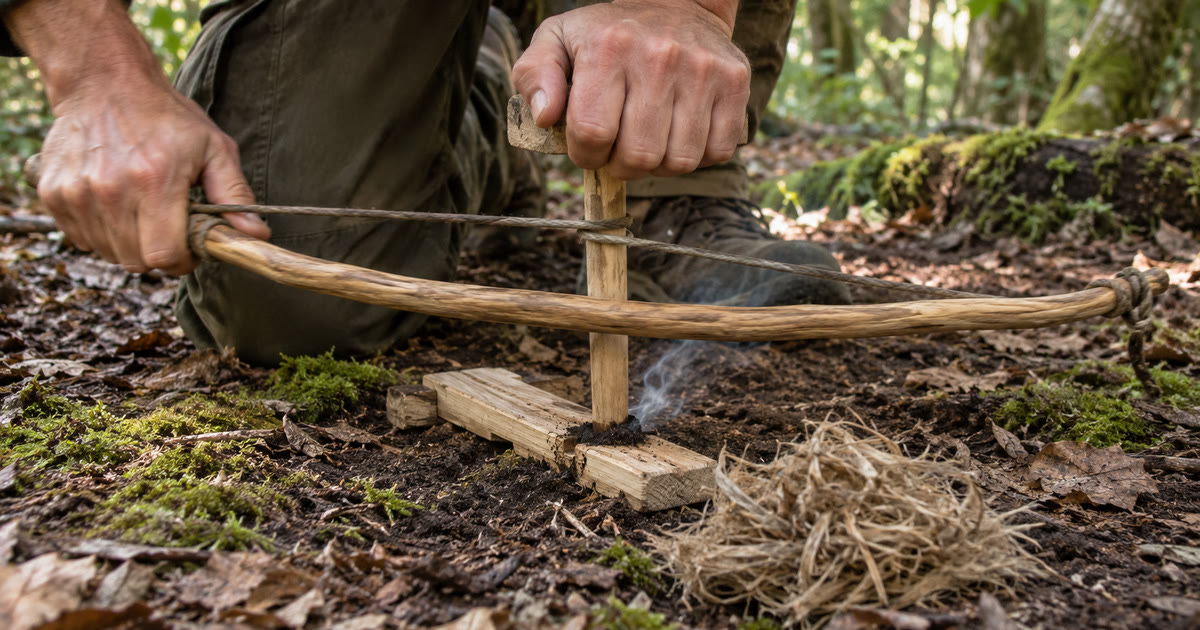
Build a bow, spindle, fireboard, and handhold from dry, dead (not rotten) softwood. Carve a notch in the fireboard, use the bow to spin the spindle fast under downward pressure until dark dust builds up and a coal forms, then tip the coal into a tinder bundle and blow it into flame. Success depends far more on dry materials and consistent technique than on strength.
The four parts of a bow-drill set
- Fireboard: a flat piece of soft, dry, dead wood (cedar, willow, cottonwood, basswood) about 3/4 inch thick.
- Spindle: a straight stick, same wood type, about 3/4 inch thick and 8–10 inches long, rounded on both ends.
- Bow: a curved stick about arm’s length with a shoelace-tight cord (paracord, natural cordage, or a bootlace) tied end to end.
- Handhold: a fist-sized piece of hardwood or stone with a shallow depression to hold the top of the spindle, ideally with a bit of grease, oil, or green leaf to reduce friction at that end only.
A dry piece of bark or a leaf to catch the coal, and a tinder bundle (dry grass, inner bark, cattail fluff) round out the set.
Preparing the fireboard
- Carve a shallow round depression near the edge of the fireboard, not the center.
- Spin the spindle in it briefly to burn in a matching round socket.
- Cut a V-notch from the edge of the board into the center of that socket, roughly a pie-slice shape reaching about two-thirds of the way to center. This notch is where the hot dust collects and forms the coal — a notch that’s too narrow or doesn’t reach the socket is the most common reason a coal never forms.
- Place a piece of bark or a leaf under the notch to catch the dust and coal.
The technique
- Loop the spindle into the bow’s cord with one twist, string tension snug but not overly tight.
- Kneel on one knee, foot of the other leg pinning the fireboard steady near the notch.
- Place the spindle in the burned-in socket, handhold on top, wrist braced against your shin for stability.
- Start with long, smooth, full-length bow strokes at a slow-to-moderate pace to warm up the socket, with light downward pressure.
- Once you see smoke consistently, increase speed and downward pressure together and keep the strokes long and even — short choppy strokes generate less heat.
- Watch for dark, fine dust piling up in the notch, and smoke that continues (or thickens) even for a second after you stop. That’s the sign a coal has formed.
- Carefully separate the spindle and fireboard without disturbing the catch material, and gently fan or blow at the coal’s edge to help it grow.
Transferring the coal to flame
- Tip the glowing coal, still on its bark catch, into the center of a loosely bundled, bird’s-nest-shaped tinder bundle (dry grass, inner bark fibers, cattail down, or dryer lint if you have it).
- Fold the bundle loosely around the coal without crushing it.
- Hold it slightly above your head, angled, and blow steadily and gently, increasing as smoke thickens.
- Once it bursts into flame, place it under your prepared kindling structure immediately.
Common mistakes and fixes
- Wood too hard or too wet: if you’re getting smoke but no dark dust, the wood is likely too hard, too resinous, or has too much moisture. Switch to a softer, drier species.
- Notch doesn’t reach the center: dust has nowhere to accumulate. Widen and deepen the notch.
- Inconsistent bowing: jerky or short strokes don’t build heat efficiently. Slow down, lengthen your strokes, and focus on smoothness before speed.
- Too much or too little downward pressure: too little and you get smoke with no dust; too much and you slow the spindle and burn out your arm. It should feel like a firm, steady push, not a stab.
- Handhold squeaking or smoking: add a little grease, oil, or a green leaf at that contact point — that end shouldn’t be generating heat.
- Cord slipping on the spindle: re-tighten the bow string; a loose cord spins the spindle unevenly.
Wood selection matters most
Cedar, willow, cottonwood, basswood, and aspen are classic, reliable choices — soft enough to generate fine hot dust quickly but not so soft they just polish smooth. Both the spindle and fireboard should generally be the same species for consistent friction. Avoid resinous woods (pine, fir) for the friction parts, since resin can gum up the socket, though pitch from these trees makes excellent tinder separately.
Practice before you need it
Bow-drill fire is a skill that looks simple and isn’t — most people fail their first several attempts, often from inconsistent technique rather than bad materials. Practice at home with known-dry wood before relying on it in the field, and always carry a ferro rod or lighter as your primary method. See our guide to starting a fire without matches for other backup techniques.
Frequently asked questions
What wood is best for a bow-drill fire?
Soft, dry, dead (not rotten) woods like cedar, willow, cottonwood, basswood, and aspen work best. They generate fine hot dust quickly without being so soft they just polish smooth, and the spindle and fireboard should generally match species.
Why isn’t my bow drill producing a coal?
The most common causes are wood that’s too hard, resinous, or damp; a notch that doesn’t reach the center of the burned-in socket, leaving nowhere for dust to collect; and inconsistent bowing speed or pressure. Fix the notch and switch to drier, softer wood first.
How long does it take to get a coal with a bow drill?
With good technique and dry materials, a coal typically forms within 30 seconds to 2 minutes of steady, fast bowing once the socket is warmed up. Beginners often take much longer, or fail entirely, due to technique rather than time.
Do the spindle and fireboard need to be the same wood?
It’s strongly recommended. Matching species and moisture content produces more consistent friction and dust than mixing a hard spindle with a soft fireboard or vice versa.
What’s the point of the notch in the fireboard?
The V-notch lets hot wood dust from the friction socket collect and pile up in one place until it reaches ignition temperature, forming an ember. A notch that’s too shallow or doesn’t reach the center of the socket is the single most common reason a coal never forms.
Is bow-drill fire a reliable primary fire-starting method?
Not for most people, especially in a real emergency with wet or unfamiliar materials and limited energy. It’s a valuable skill worth practicing, but a lighter and ferro rod should always be your primary fire-starting tools.
Bottom line
Bow-drill fire comes down to dry matched wood, a properly carved notch, and smooth, consistent bowing that builds heat rather than choppy strokes. Practice it at home in good conditions until you can reliably get a coal, and always carry a lighter and ferro rod as your real backup.
Related guides
🔥 How to Start a Fire Without Matches
🌪️ How to Build a Fire in the Rain
🥩 15 Wilderness Survival Skills
This article is for general informational purposes only. Practice in a safe, controlled area and follow local fire restrictions. Sources: U.S. Forest Service and National Park Service wilderness skills guidance; widely published bushcraft instruction (Boulder Outdoor Survival School, Pathfinder School methodology).