
The Survival Life is reader-supported. When you buy through links on our site, we may earn an affiliate commission at no extra cost to you. As an Amazon Associate we earn from qualifying purchases. Learn more.
“Grid-down” covers any event that takes out electricity and the services riding on it for days to weeks — a cyberattack on a utility, a severe geomagnetic storm, an EMP, cascading equipment failure, or prolonged severe weather. The causes differ; the household response is mostly the same. This guide covers grid-down preparedness without the doom — what stops working, in what order, and how to prepare for it.
Quick answer
Prepare for a 2–4 week loss of power, water pressure, refrigeration, card payments, fuel pumps, and cell service. The priorities in order: water (store it and be able to treat more), food that needs no refrigeration or grid to cook, heat/cooling and light, sanitation, communication and information (battery radio), medical and prescriptions, and cash. The same kit covers hurricanes, ice storms, and utility failures, so nothing here is wasted.
What actually fails, and when
- Minute 1: lights, outlets, internet, electric heat/AC, electric stoves, garage-door openers.
- Hour 1–12: phones lose charge; cell towers run on backup batteries (often 4–8 hours) then generators, then fail; traffic signals down.
- Hour 12–48: municipal water loses pressure once tower reserves drain and pumps are off; “boil water” notices (but you can’t boil easily); food in the fridge is unsafe after ~4 hours, freezer after ~24–48; gas stations can’t pump; stores close or go cash-only then sell out.
- Day 2–7: home heating oil/propane not delivered; ATMs empty; sewage lift stations back up in some areas; medical facilities on generator only.
- Week 2+: fuel, food, and medicine resupply becomes the central problem; normal routines have to be replaced with manual ones.
The seven priorities
1. Water
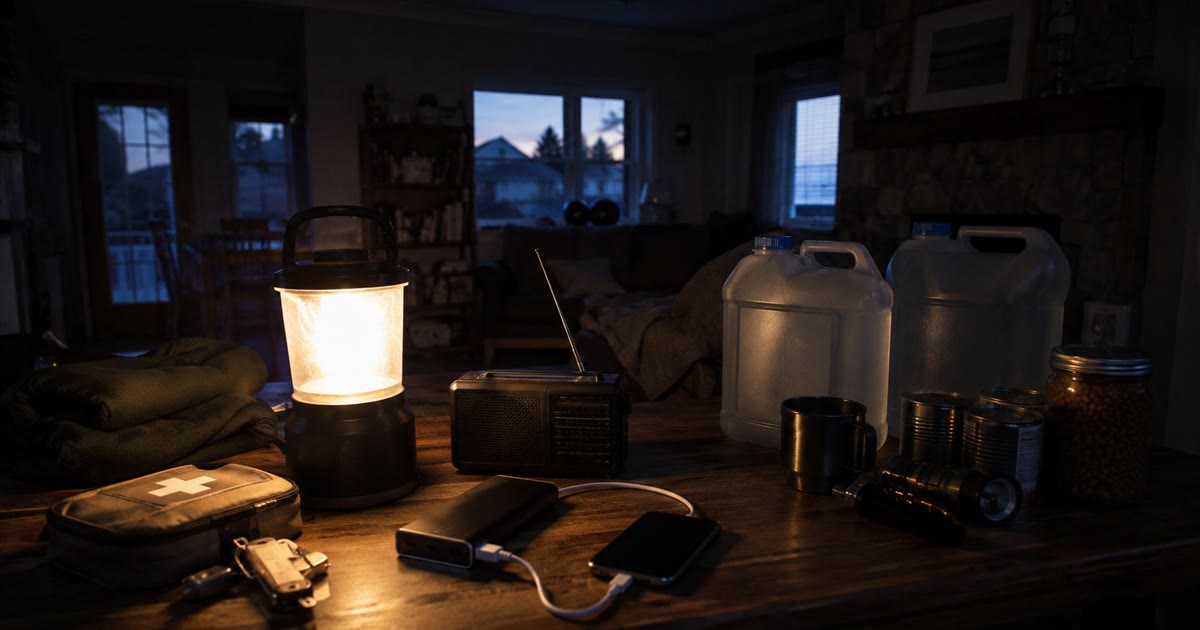
Store one gallon per person per day for two weeks minimum (more for heat, pets, and hygiene). Add a way to treat more: a good gravity or pump water filter, plus unscented household bleach or tablets for disinfection. Fill the bathtub and every container at the first warning. Know your water heater (40–50 gallons) and toilet tanks as reserves. See how to purify water.
2. Food and cooking
Two to four weeks of shelf-stable food that needs little or no cooking: canned goods, rice and beans (if you can cook), oats, nut butter, pasta, shelf-stable milk, comfort foods. A way to cook off-grid — propane or butane stove used outdoors, plus a wood option. Eat the fridge first, then the freezer, then the pantry. See emergency food supply and survival stoves.
3. Heat, cooling, and light
- Cold climates: a safe indoor-rated heater (and its fuel), or a plan to close off and heat one room with body heat, sleeping bags, and layers. Never run a generator, grill, or unvented fuel heater indoors.
- Hot climates: shade, cross-ventilation, wet cloths, hydration, and moving activity to the cool hours; identify a cooling center you could reach.
- Light: headlamps and lanterns for every person, with a big stock of batteries; a solar charger and a power station for phones, radios, and medical devices.
4. Sanitation
If water stops, don’t flush with drinking water. Set up a bucket toilet with heavy liners, sawdust or kitty litter, and a lid; store toilet paper, wet wipes, hand sanitizer, garbage bags, and gloves. Poor sanitation is what turns a blackout into an illness outbreak.
5. Communication and information
A battery or hand-crank AM/FM/NOAA weather radio is the single most important information tool — it works when the internet doesn’t. Agree on an out-of-area contact for the family, a physical meeting place, and written phone numbers. A pair of GMRS/FRS radios covers the neighborhood. Keep devices off or in low-power mode to stretch batteries.
6. Medical and prescriptions
Keep a stocked first aid kit and know how to use it. Ask your pharmacy and doctor about an emergency supply of essential prescriptions and about keeping temperature-sensitive medication (like insulin) cool without power. List everyone’s medications, doses, allergies, and conditions on paper. See building a first aid kit.
7. Cash and documents
Card networks and ATMs need power. Keep enough small-denomination cash for one to two weeks of essentials. Keep copies of ID, insurance, deeds, and prescriptions in a waterproof folder and on an encrypted drive.
About EMP and solar storms specifically
A high-altitude nuclear EMP or a rare severe geomagnetic storm could damage grid transformers and some unshielded electronics, potentially causing a long, wide outage. There is a lot of exaggeration about it. Practical, non-paranoid steps: everything above (which is what actually keeps you alive), plus optionally keeping a few spares — an old radio, a basic multimeter, headlamps, chargers — in a grounded metal box or ammo can lined with cardboard. Cars almost certainly keep running. Don’t spend on exotic shielding before you’ve covered water, food, and sanitation.
If it lasts longer than your supplies
- Ration early, not late. Cut consumption on day one, before you know how long it will last.
- Cooperate with neighbors. Pooled tools, skills, water, and a watch rotation beat every household alone. This is the single biggest force multiplier.
- Keep a routine: water, food, sanitation, information, rest — every day, in that order.
- Have a bug-out threshold. Decide in advance what would make you leave (no water for X days, no heat in a hard freeze, civil breakdown) and where you’d go. See bug out vs bug in.
Frequently asked questions
How long should I prepare to be without power?
Two weeks is a solid baseline for most households; four weeks is better if you have space and budget. That range covers the vast majority of real outages from weather, equipment failure, and cyber incidents, and the same supplies serve a long-duration grid-down event.
What stops working first in a grid-down event?
Electricity and internet immediately, then cell service within hours as tower backups drain, then municipal water pressure within 12 to 48 hours, then refrigeration, card payments, and fuel pumps. Resupply of fuel, food, and medicine becomes the main problem after the first week.
Do I need a Faraday cage for EMP prep?
It’s optional and low priority. Covering water, food, cooking, sanitation, light, and communication is what keeps you alive in any long outage. If you want, store a few backup electronics in a grounded metal container, but do that only after the basics are done.
Will my car work after an EMP?
Almost certainly yes. Testing has shown most vehicles are minimally affected or recover after a restart. Fuel availability, not the vehicle itself, is the bigger constraint, so keep tanks at least half full.
Why is cash important if the grid goes down?
Payment card networks, ATMs, and point-of-sale systems all depend on electricity and communications. Stores that stay open often go cash-only. A one-to-two-week supply of small bills lets you buy essentials while electronic payment is down.
Is a generator worth it?
For many households, yes, for a fridge, freezer, medical devices, and furnace fan — but only run it outdoors, away from windows, with a carbon monoxide detector inside, and store fuel safely with stabilizer. A portable power station with solar is a quieter, indoor-safe option for smaller loads.
Bottom line
Whatever the cause, a long power loss comes down to water, food, heat or cooling, light, sanitation, information, medicine, and cash — for two to four weeks, plus neighbors you can work with. Build that and you’re ready for a grid-down scenario without organizing your life around the scariest version of it.
Related guides
🔌 How to Prepare for a Long-Term Power Outage
🔒 Bug Out vs Bug In: Which Plan Do You Need?
📻 Best Two-Way Radios for Emergencies
This article is for general informational purposes only. Sources: Ready.gov power-outage and blackout guidance; FEMA “Power Outage” and continuity materials; CISA reporting on grid and cyber threats; U.S. congressional EMP Commission summaries; NOAA Space Weather Prediction Center.