
This site stays free thanks to small commissions from links like the ones below — it never costs you anything extra, and it never changes what we recommend. As an Amazon Associate we earn from qualifying purchases. Learn more.
Search “everyday carry” and you get a wall of tactical knives, titanium gadgets, and gear that would get a normal person a strange look at the office. Strip away the theater, and everyday carry for emergencies is a short, practical list: the few things that turn a bad moment — a power outage, a fender bender, a cut, a stranded evening — from a crisis into an inconvenience. This is a practical EDC list built around real, common problems, with three ways to scale it and a printable checklist.
Quick answer
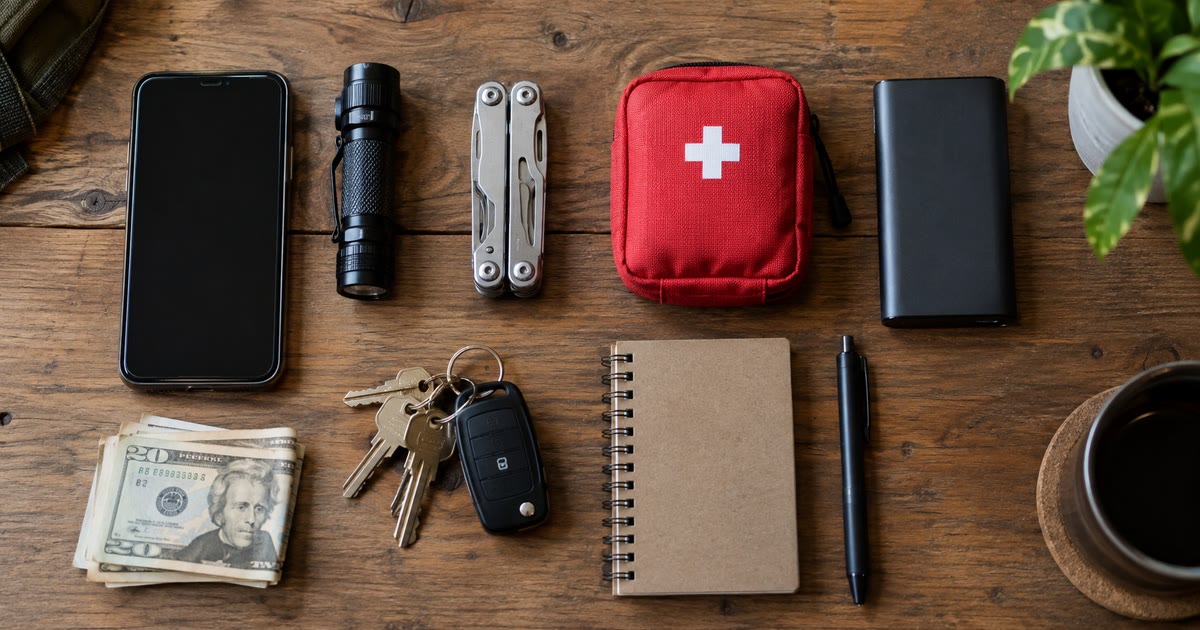
On your person: a phone, ID and some cash, keys, a small flashlight, and a compact multitool or pocket knife if your setting allows one. In your daily bag: a phone power bank and cable, a mini first aid kit, a water bottle, a snack, a compact rain layer, a pen and paper, and any personal medication. Your car carries the bulky backups. Everything else is optional.
Your EDC at a glance
| Item | Where | Target size / spec | Why it earns a spot | Priority |
|---|---|---|---|---|
| Phone | — | Communication, maps, camera, SOS | Essential | |
| ID + cash | Wallet | $40–$100 small bills | Works when card networks are down | Essential |
| Keys + keychain light | <1 oz light | Access; a backup light that’s always there | Essential | |
| Flashlight | <3 oz, USB-C, ~150+ lumens | Independent light; spares the phone | Essential | |
| Multitool / knife | Pocket or bag | <5 oz | Cutting, opening, minor repairs | Useful (law permitting) |
| Power bank + cable | Bag | 10,000 mAh | Roughly 1–2 phone charges | Essential |
| Mini first aid kit | Bag | <8 oz | Cuts, blisters, headaches, meds | Essential |
| Water bottle | Bag | 16–24 oz | Delays, heat, dehydration | Useful |
| Snack | Bag | 200–400 cal | A long evening doesn’t become a bad one | Useful |
| Rain shell / poncho | Bag | <10 oz | Exposure protection | Useful |
| Pen + notepad | Bag | — | Numbers, addresses, a note on a door | Useful |
Three EDC tiers: pick the one that fits your day
Don’t copy a stranger’s loadout. Start at the tier that matches your life and add up from there.
Tier 1 — Minimal EDC (5 items, always on you)
Phone • wallet with ID and cash • keys • small flashlight • multitool or pocket knife. This is the pocket layer. If it’s not small enough to carry every day without thinking, trim it.
Tier 2 — Everyday bag (add ~5 items)
Everything above, plus: power bank and the right cable • mini first aid kit • water bottle • a snack • a compact rain layer. This covers the large majority of everyday disruptions.
Tier 3 — Full commuter / parent EDC (add ~5 more)
Everything above, plus: a Mylar blanket • two N95 masks • a whistle • a lighter • a few days of critical medication and a written emergency-contact card. Build this if you commute far, travel with kids, or live somewhere with hard winters or frequent outages. If your walk home is long, step up to a full get-home bag.
What each emergency actually needs
This is why each item is on the list — not “because everyone carries it,” but because it solves a specific, common problem.
| Situation | The items that actually help |
|---|---|
| Power outage (home or building) | Flashlight, phone, power bank |
| Car breakdown / roadside wait | Flashlight, water, snack, rain layer, power bank |
| Minor injury (cut, blister, burn) | Mini first aid kit |
| Transit shutdown / long delay | Water, snack, cash, power bank, comfortable shoes |
| Phone network down | Cash, written phone numbers, a paper map |
| Sudden bad weather | Rain shell, Mylar blanket, hat/gloves in winter |
| Evacuation from work | Flashlight, water, power bank, cash, meds, contact card |
| Smoke or dust in the air | N95 mask |
The pocket layer (always on you)
- Phone — your light, map, camera, radio, and lifeline. Keep it charged and learn how to trigger its emergency SOS and set up its medical ID.
- ID + cash + a card — $40–$100 in small bills is enough for most everyday disruptions; adjust for your commute and local costs. During outages and disasters, card readers and ATMs often go down.
- Keys — with a tiny keychain flashlight and maybe a keychain multitool.
- Small flashlight — a real one beats a phone light: it lasts longer, frees your phone, and won’t die when you need the phone. A pocket EDC light is the single most useful upgrade for most people.
- Pocket knife or multitool — opening packages, cutting a seatbelt or a stuck zipper, a splinter, food. A modest non-locking knife or a compact multitool covers almost everything. Check local laws and workplace rules first — a confiscated tool helps nobody.
The bag layer (purse, backpack, tote)
- Power bank + the right cable — a 10,000 mAh bank gives roughly one to two full smartphone charges, depending on the phone and conversion losses. Test that the cable actually fits your phone.
- Mini first aid kit — bandages, gauze, tape, antiseptic wipes, blister care, pain reliever, and any personal meds. See how to build a first aid kit. If your work, travel, or hobbies create a meaningful risk of severe bleeding, consider carrying a reputable commercial tourniquet — and get hands-on training before relying on it.
- Water bottle + a snack — a bottle and an energy bar so a delayed evening doesn’t turn miserable.
- Compact rain layer — a packable shell or at least an emergency poncho.
- Pen and a small notepad — phone numbers, an address, an insurance exchange, a note left on a door.
- Extras that weigh almost nothing: a Mylar blanket, a whistle, a couple of N95 masks, hand sanitizer, a lighter, a few feet of tape wrapped around the pen.
The car layer
Your vehicle carries the bulky items your pockets can’t: a full first aid kit, a blanket, water and food, jumper cables or a jump-starter pack, a window breaker and seatbelt cutter, a flashlight, a charger, and seasonal gear (a shovel and traction aid in winter, extra water in summer). If you commute, build this into a proper get-home bag.
Our practical picks
Reader-supported — we may earn a commission at no cost to you. Specs matter more than brand names, and prices change, so check current listings.
Compact flashlight
Prioritise USB-C charging, a pocket clip, roughly 150–700 lumens, and a genuinely usable low mode. Runtime on medium matters more than a big turbo number. Well-regarded options: the Olight i5R EOS and the Streamlight MicroStream USB.
Slim power bank
10,000 mAh is the sweet spot — one to two phone charges without a brick in your bag. Look for USB-C in and out and a low-current mode for small devices. The Anker PowerCore Slim 10000 is a common, unfussy choice.
Compact multitool
Pliers, one good blade, a couple of screwdriver bits and scissors, all under about 5 oz so you actually carry it. The Leatherman Skeletool keeps it minimal; a Victorinox Climber is the lighter, office-friendly route.
Mini first aid kit
Buy a small pre-made pouch as a base, then add your own medications, extra blister tape, and anything specific to your needs. Compact options like the Adventure Medical Kits .5 fit a jacket pocket.
For the full breakdown and head-to-head comparisons, see our dedicated guides to the best EDC flashlights and emergency radios.
Printable EDC checklist
Print this or save it to your phone. Tick what you already carry; fill the gaps one item at a time.
Pocket:
☐ Phone (charged) ☐ ID ☐ Cash ($40–$100) ☐ Keys + light ☐ Flashlight ☐ Multitool / knife
Bag:
☐ Power bank ☐ Charging cable ☐ Mini first aid kit ☐ Medication ☐ Water bottle ☐ Snack ☐ Rain shell / poncho ☐ Pen + notepad
Add for a longer commute:
☐ Mylar blanket ☐ N95 masks ☐ Whistle ☐ Lighter ☐ Emergency contact card
What most people can skip
- A “tactical” fixed-blade knife for city life — a small folder or multitool does everything you’ll actually do.
- Redundant gadgets — three flashlights, two multitools. Carry one good version of each.
- Anything you won’t carry every day. The best EDC is the one that’s actually in your pocket, not the impressive kit in a drawer.
- Gear that breaks workplace or local rules.
How to build your kit
Start with what you already carry and add one item at a time: a real flashlight this month, a power bank and cable next, a mini first aid kit after that. Carry it for a few weeks, notice what you reach for and what just adds weight, then adjust. Keep the pocket layer small enough that you never leave it behind, and let the bag and car carry the rest.
Common mistakes
- Over-building the pocket layer until it’s too bulky to carry — so you stop carrying it.
- A power bank with the wrong cable — a useless brick when you need it.
- Buying gear you can’t legally carry where you live or work.
- No first aid — the one category almost everyone actually uses.
- Never testing it — dead power bank, expired meds, a light with corroded batteries.
Frequently asked questions
What should everyone carry every day for emergencies?
A charged phone, ID and some cash, keys with a small light, a compact flashlight, and a pocket knife or multitool if allowed. In your bag: a phone power bank and cable, a mini first aid kit, water, a snack, a rain layer, a pen and paper, and any personal medication.
Do I need a knife in my everyday carry?
A small blade or multitool is genuinely useful for daily tasks and minor emergencies, but it’s optional and depends on local laws and workplace rules. If you can’t or don’t want to carry one, small scissors in your bag cover most needs.
Is a phone flashlight good enough, or do I need a separate one?
A dedicated flashlight is better: it’s brighter, lasts longer, and doesn’t drain the phone you may need for calls, maps, or an SOS. A small rechargeable EDC light or keychain light is a low-cost, high-value addition.
What is the most useful item in an everyday carry kit?
For many people, a small first aid kit is one of the most practically useful additions, because cuts, blisters, headaches, and minor injuries are far more common than major disasters. A close second is a charged phone plus a power bank, since communication and information drive every other decision.
How much cash should I keep in my EDC?
Around $40 to $100 in small bills, kept separate from your wallet, and adjusted for your commute and local costs. During outages and disasters, card networks and ATMs often go down, and small bills matter because nobody can make change.
What’s the difference between EDC and a get-home bag?
EDC is the minimal set of useful items you carry every single day. A get-home bag is a larger, dedicated kit kept in your car or at work, built specifically to help you travel home on foot if transportation fails.
Bottom line
Skip the tactical cosplay. A charged phone, cash, a real flashlight, a small blade or multitool, and a bag with a power bank, first aid, water, and a rain layer will carry you through the emergencies normal people actually face. Pick the tier that fits your day, build it one item at a time, carry it every day, and test it twice a year.
Next: build your emergency system
👜 Get-Home Bag Checklist for Commuters
🩹 How to Build a Survival First Aid Kit
💡 How to Prepare for a Long-Term Power Outage
🏠 Bug Out vs. Bug In vs. Get Home
This article is for general informational purposes only. Check the knife and tool laws where you live and any rules where you work. Sources: Ready.gov “Build a Kit”; American Red Cross “Survival Kit Supplies”; National Safety Council on vehicle emergency kits.