
This site stays free thanks to small commissions from links like the ones below — it never costs you anything extra, and it never changes what we recommend. As an Amazon Associate we earn from qualifying purchases. Learn more.
A good water filter turns a stream, lake, or questionable tap into something safe to drink in seconds, but “filter” covers a wide range of devices with very different capabilities. This guide covers best survival water filters: the main types, what micron rating actually means, and which filter fits which use case.
Quick answer
Match the filter to the threat: for backcountry water with bacteria and protozoa (the main U.S. wilderness risk), a 0.1-micron hollow-fiber filter (Sawyer, LifeStraw style) handles it well and is light and cheap. For international travel or water that might carry viruses, you need a filter rated for viruses or a combined filter+UV/chemical approach, since standard hollow-fiber filters don’t reliably remove viruses.
Understanding micron ratings
- Protozoa (Giardia, Cryptosporidium): 1–15 microns — removed by nearly any filter rated 1 micron or smaller.
- Bacteria (E. coli, Salmonella): about 0.2–2 microns — need a filter rated 0.2 microns or smaller.
- Viruses: as small as 0.02 microns — most portable filters don’t remove these; you need a filter specifically rated for viruses, or a secondary step (chemical treatment, UV, or boiling).
- In most of the U.S. backcountry, bacteria and protozoa are the realistic threat, which is why a 0.1-micron filter covers the common case; international travel to areas with poor sanitation raises virus risk significantly.
Filter types
Hollow-fiber squeeze/gravity filters
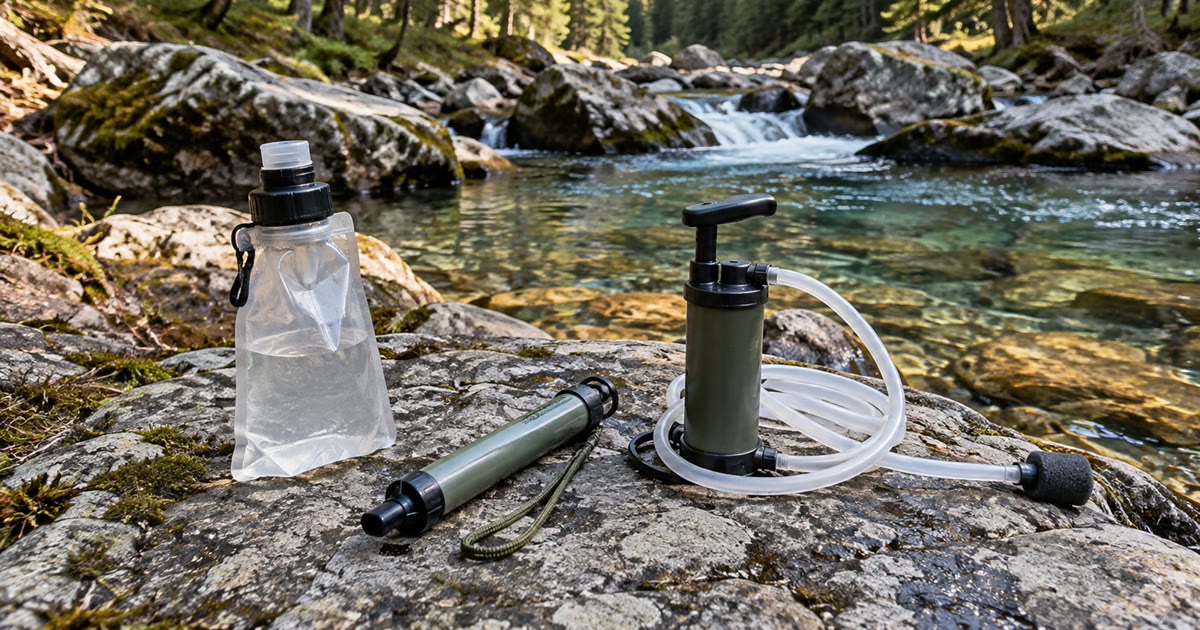
The standard lightweight backcountry choice — a Sawyer-style filter screws onto a standard water bottle or squeeze pouch, removing bacteria and protozoa effectively. Cheap, light, no batteries, but can clog with silty water (back-flush regularly) and doesn’t remove viruses.
Straw filters
Drink directly from the source through the filter — simplest form factor, good for a personal emergency kit, but you can’t pre-filter water to carry with you, only drink on the spot.
Pump filters
Mechanically pump water through a filter cartridge, often with a pre-filter for silty water and higher flow rates than squeeze filters — heavier and more parts to maintain, but good for groups or base camp use.
Gravity filters
Fill a dirty-water bag, hang it, and let gravity push water through the filter into a clean container — hands-free and good for filtering larger volumes for a group, slower than pumping.
Bottle filters
An integrated filter inside a drinking bottle — convenient for everyday carry and travel, though capacity and flow rate are usually lower than dedicated field filters.
UV purifiers
A UV purifier (like a SteriPen) uses ultraviolet light to inactivate bacteria, protozoa, AND viruses — a real advantage over standard filters. Requires batteries, works best on already-clear water (cloudy water blocks the UV from reaching all pathogens), and doesn’t remove sediment.
Combined filter + chemical systems
Some systems pair a standard filter with a chemical cartridge or require you to add purification tablets afterward specifically to cover viruses, combining the strengths of mechanical filtration and chemical disinfection.
Flow rate and clogging
Hollow-fiber filters slow down as they clog with sediment, especially in silty water. Back-flushing (pushing clean water backward through the filter) restores most lost flow rate, and it’s worth doing regularly rather than waiting until the filter is nearly unusable. A pre-filter (even a bandana or coffee filter) for visibly dirty water extends the main filter’s working life significantly.
Cold weather considerations
Water left inside a hollow-fiber filter can freeze and crack the membrane, ruining it without visible damage — a cracked filter can then pass contaminated water without you knowing. In freezing conditions, keep the filter warm against your body or dry it out fully between uses. See our full guide to purifying water in the wild for the complete comparison of filtering, boiling, and chemical methods, and what to do when filters aren’t available.
Choosing for your actual use case
- Weekend backpacking, U.S. wilderness: a lightweight hollow-fiber squeeze or straw filter.
- Group base camp or longer trips: a pump or gravity filter for higher volume and flow rate.
- International travel: a filter plus UV or chemical step to cover viruses, or a combined system rated for all three pathogen types.
- Home emergency kit: a durable filter rated for high volume, paired with stored water and a backup disinfection method.
Frequently asked questions
What micron rating do I need for a water filter?
0.2 microns or smaller removes bacteria and protozoa, the main backcountry risk in most of the U.S. For areas where viruses are a concern (often international travel), you need a filter specifically rated for viruses or an added chemical or UV step.
Do water filters remove viruses?
Most standard hollow-fiber filters do not, since viruses are smaller than the filter’s pore size. UV purifiers and specific virus-rated filters or chemical treatments are needed to address viral contamination.
Can a water filter freeze and be ruined?
Yes. Water trapped inside a hollow-fiber filter can freeze and crack the membrane without visible damage, after which it may pass contaminated water undetected. Keep filters warm or fully dried out in freezing conditions.
What’s the difference between a squeeze filter and a gravity filter?
A squeeze filter requires manually pushing water through with your hands, good for solo use. A gravity filter hangs a bag of water above a clean container and lets gravity do the work, better for filtering larger volumes hands-free for a group.
Why does my water filter get slower over time?
Sediment clogs the filter’s pores as you use it, especially in silty water. Regular back-flushing restores most of the lost flow rate, and using a pre-filter for visibly dirty water extends the main filter’s working life.
Is a UV purifier better than a filter?
They solve different problems. A UV purifier inactivates bacteria, protozoa, and viruses but doesn’t remove sediment or work well in cloudy water. A filter removes particles and most pathogens mechanically but typically misses viruses. Many people use both.
Bottom line
Match the filter to your actual risk: a 0.1 to 0.2-micron hollow-fiber filter covers most U.S. backcountry use, while international travel or higher-risk water needs a virus-rated filter or an added UV/chemical step. Protect any filter from freezing, and back-flush regularly to keep flow rate up.
Related guides
💧 How to Purify Water in the Wild
💧 How to Store Water for Emergencies
⏱️ How Long Can You Survive Without Water?
This article is for general informational purposes only. Product availability, pricing, and specifications change; check current listings. Sources: CDC safe water guidance; EPA drinking water treatment technology guidance; manufacturer specifications (Sawyer, LifeStraw, Katadyn, SteriPen).