
This site stays free thanks to small commissions from links like the ones below — it never costs you anything extra, and it never changes what we recommend. As an Amazon Associate we earn from qualifying purchases. Learn more.
Quick answer: Store 1 gallon of water per person per day, for a minimum of 2 weeks (14 gallons per person). Use food-grade containers, keep them away from light and chemicals, and rotate commercially bottled water every 1-2 years — properly treated tap water in sealed food-grade containers can last 6-12 months before you should rotate it.
How Much Water Do You Actually Need?
FEMA’s baseline is 1 gallon per person per day, split roughly between drinking (half a gallon) and hygiene/cooking (half a gallon). That’s a minimum, not a comfortable number — hot climates, pregnant or nursing people, children, and anyone sick need more. A family of four planning for two weeks needs 56 gallons minimum. For a month, that’s 120 gallons — which is why most serious preppers move to 55-gallon drums rather than trying to store hundreds of individual bottles.
| Household size | 3 days | 2 weeks | 1 month |
|---|---|---|---|
| 1 person | 3 gal | 14 gal | 30 gal |
| 2 people | 6 gal | 28 gal | 60 gal |
| 4 people | 12 gal | 56 gal | 120 gal |
Best Containers for Long-Term Water Storage
Not all plastic is safe for years of storage. Look for containers marked HDPE (recycling code 2), which resists leaching and cracking. Avoid reusing milk jugs — the protein residue is nearly impossible to fully clean and becomes a bacteria source.
- WaterBrick / stackable 3.5-gallon jugs: good middle ground — portable enough to carry, big enough to matter.
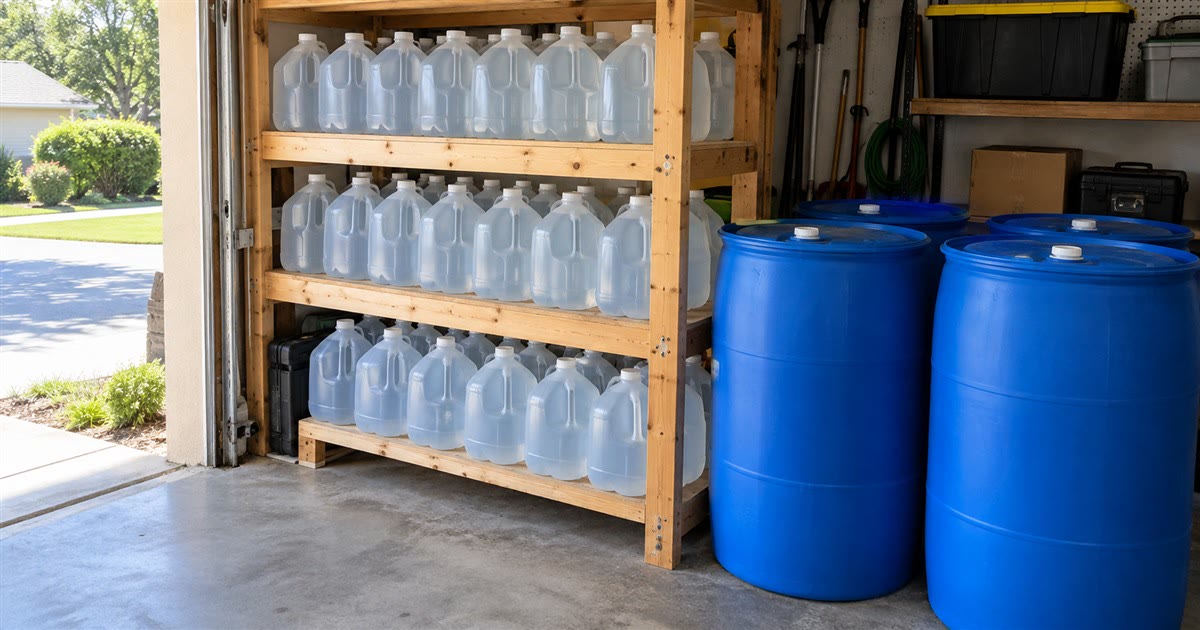
- 55-gallon food-grade barrels: the most water per square foot of storage space, but need a hand pump or siphon to access, and a full barrel weighs over 450 lbs — plan the location before you fill it.
- Commercially bottled water: zero prep required, sealed for years, but bulkiest per gallon and most expensive.
- 7-gallon stackable water containers — Check Price on Amazon
- 55-gallon water storage barrel with bung wrench — Check Price on Amazon
- Barrel hand pump/siphon — Check Price on Amazon
- Water preserver drops (for treating stored tap water) — Check Price on Amazon
How to Prepare Tap Water for Storage
If your tap water is already chlorinated municipal water, you generally don’t need to add anything — just store it in a clean, sanitized, food-grade container with a tight lid. If you’re unsure of the source (well water, etc.), treat it first: add 1/8 teaspoon of unscented liquid chlorine bleach (5-9% sodium hypochlorite, no additives) per gallon, mix, and let stand 30 minutes before sealing.
Where to Store It
Keep containers off concrete floors (concrete can leach chemicals through plastic over time — set them on a wood pallet or shelf), out of direct sunlight, and away from gasoline, pesticides, or solvents, which can permeate plastic and taint the water. A cool, dark closet, basement, or garage corner works well.
Common Mistakes
Frequently Asked Questions
Does stored water expire?
Commercially bottled water doesn’t spoil, but manufacturers put a 1-2 year date on the bottle for quality/plastic-degradation reasons. Properly treated tap water in a sealed food-grade container is generally safe well past a year — if it’s been stored correctly, but you should still rotate it and re-treat if the taste or smell changes.
Can I store water in a used soda bottle?
Yes — 2-liter soda bottles are actually one of the better reuse options because they’re made of PET plastic and designed to hold pressurized liquid. Wash thoroughly, sanitize with a bleach solution, rinse well, then fill with treated water.
How do I know if stored water has gone bad?
Look for cloudiness, a change in smell, or a slimy feel to the container. When in doubt, re-treat with a few drops of unscented bleach or run it through a filter before drinking.
What’s the cheapest way to store a lot of water?
Food-grade 55-gallon barrels bought used from a beverage or syrup supplier (thoroughly cleaned) are usually the lowest cost per gallon, though you’ll need a separate pump to access the water.